What Meta Is Actually Betting On with Muse Spark
Muse Spark uses 58M output tokens where Claude uses 157M on the same test. Meta's newest frontier AI already powers chat for 3 billion people.
TL;DR: Meta launched Muse Spark on April 8, 2026. Most commentary split into two camps. Meta went closed because Meta won. Meta went closed because Meta lost. Both miss what Meta actually built. Muse Spark does frontier-class reasoning in less than half the output tokens Claude Opus 4.6 and GPT-5.4 spend on the same benchmark, and Meta AI, the product serving roughly three billion daily active users, runs on it. Read Muse Spark as an efficiency-first, patiently sequenced, consumer-scale bet, and the choices that look strange on their own start fitting together.
The week Muse Spark launched, the conversation split almost immediately. One camp said Meta finally caught up and closed the doors. Another said Meta finally fell behind and is hiding it. Both sides were arguing about the license. Neither was arguing about the model.
The bet Meta actually made isn't captured by the license. It's captured by three choices that are easy to miss through the open-weights lens. Muse Spark is designed for fewer tokens per query. It is framed as step one of a long sequence. And it is shipping first as the engine of a consumer product reaching three billion daily active users. Those three choices, taken together, describe a different game than the one most labs are playing.
What Muse Spark is
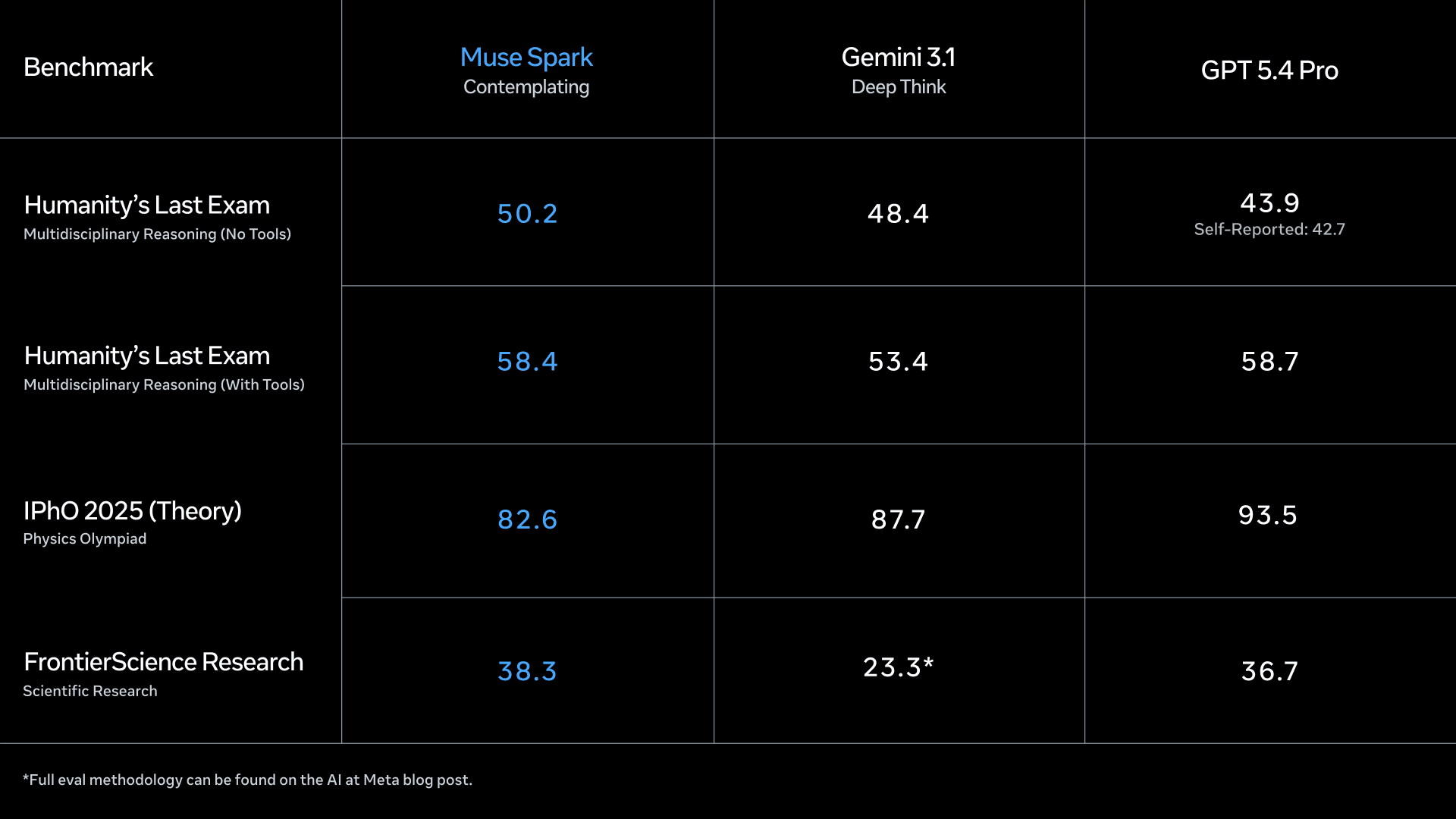
Muse Spark is Meta Superintelligence Labs' first model, shipped April 8 after a nine-month rebuild of Meta's AI infrastructure. [1] It is a natively multimodal reasoning model with three modes. Instant for fast responses. Thinking for reasoning-heavy queries. Contemplating, positioned against Gemini Deep Think and GPT Pro for long scientific work. It supports tool use, visual chain of thought, and multi-agent orchestration. [2]
Meta AI, the consumer product on meta.ai and the Meta AI app, runs on it today. The Muse Spark API is in private preview for selected partners. Alexandr Wang, Meta's Chief AI Officer, has said broader API access is coming. [3] The weights have not been released, and Meta has not committed to whether or when they will be.
On the Artificial Analysis Intelligence Index v4.0, Muse Spark scores 52. GPT-5.4 and Gemini 3.1 Pro Preview score 57. Claude Opus 4.6 scores 53. [4] Fourth at the frontier, as the frontier is currently measured.
Efficiency is the number that matters
Meta's headline technical claim is that Muse Spark reaches its capabilities with over an order of magnitude less compute than Llama 4 Maverick, the prior Meta flagship. [1] That is a training-side claim. The more interesting number sits on the inference side.
To complete the Artificial Analysis Intelligence Index v4.0 run, Muse Spark used 58 million output tokens. Claude Opus 4.6 used 157 million. GPT-5.4 used 120 million. [4] Muse Spark reaches roughly the same tier of performance while spending less than half the thinking time of its closest competitors.
Meta calls the mechanism thought compression. During reinforcement learning, the model is penalized for excessive reasoning tokens. It is trained to reach the same answer with fewer intermediate steps. [4]
Zoom out. Llama 4 Maverick scored 18 on the same index. Muse Spark scores 52. [4] Nearly 3x jump in one release, using roughly a tenth of the training compute, producing a model that serves answers in less than half the output tokens of its peers. That is not a fourth-place story. It is a different-axis story.
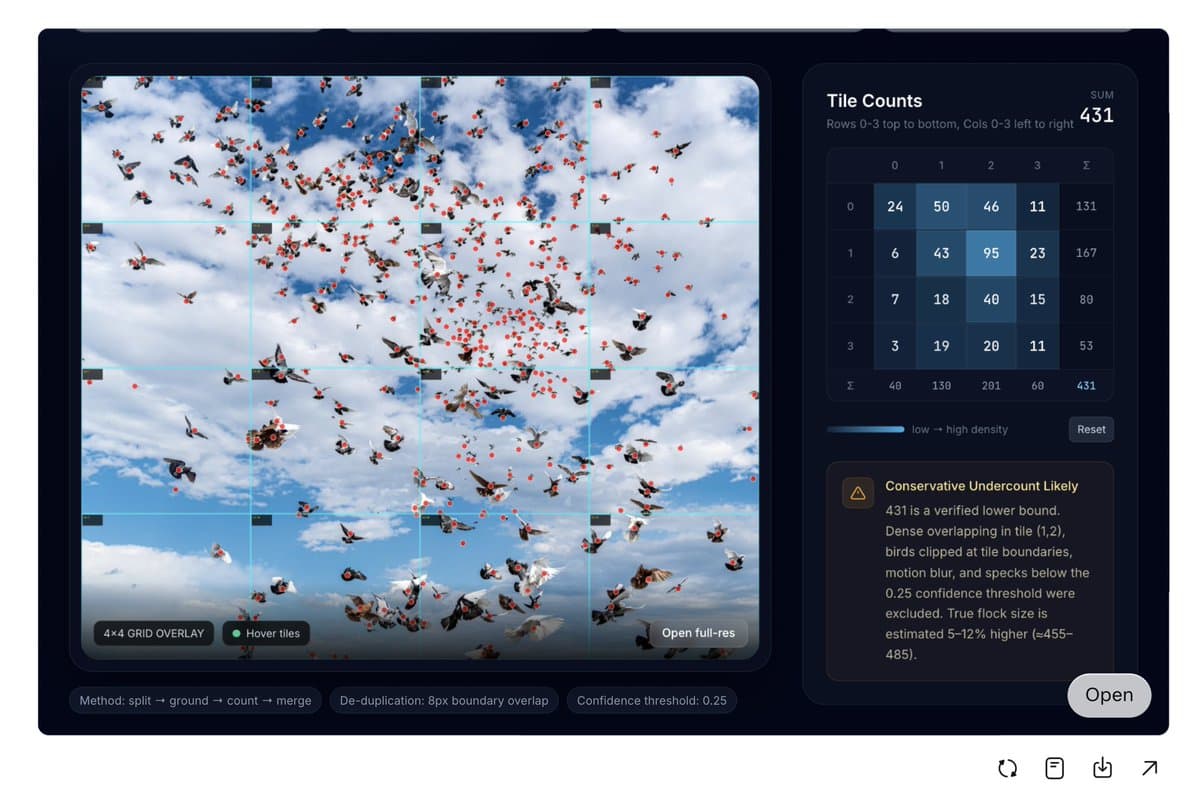
Thought compression isn't the only lever. Fei Xia, a Meta researcher, showed Muse Spark tackling a hard visual counting task using parallel subagents: divide the image into a grid, assign a subagent per tile, merge the counts. [5] That is a second axis of test-compute scaling. Not fewer tokens per query, but many smaller queries instead of one large one. Both compound efficiency at inference time.
Matt Ridley, in How Innovation Works, argues that real technological progress almost never looks like a breakthrough in the moment. It looks like compounded efficiency. [6] The Wright brothers didn't fly higher than their competitors; they iterated longer. Meta's claim with Muse Spark is that the same mechanism is back in large language models as the active design constraint. Fewer tokens per query, optimized over releases, compounded.
Under the efficiency thesis, the contribution is the training recipe, not the weights. The productized result at three billion DAUs is what the recipe is for.
Patience as a structural choice
Wang's launch thread called Muse Spark "step one." [3] Meta has named three modes, shipped two of them, and placed Contemplating on a published roadmap. The release itself followed a nine-month rebuild of Meta's internal AI infrastructure before any new model went out. [1]
That pattern is uncommon. Labs announce quarterly, deprecate on shorter cycles, and trade nomenclature every six weeks. A frontier lab committing to a staged ladder with named but unbuilt later steps is the exception.
Jeff Bezos's 1997 shareholder letter made a version of this argument on its own: "We will continue to make investment decisions in light of long-term market leadership considerations rather than short-term profitability considerations." [7] Most companies quote the line. Very few behave like it. Muse Spark is Meta behaving like it. A nine-month silence, a named sequence, an efficiency-first architecture that only pays back at scale.
Patience has a failure mode. If the ladder breaks, the gap widens. If competitors keep improving quarterly and Muse Spark's step two arrives in 2027, the index score will read worse, not better. That is the actual risk of the strategy. Not the license. The cadence.
The game Meta is actually playing
Roughly three billion daily active users touch Meta's products. Muse Spark powers Meta AI across them. [1] Every prompt, every caption suggestion, every smart reply, every image generation across meta.ai, Instagram, WhatsApp, and Facebook is a query served at Meta's cost.
Reread the efficiency numbers with that denominator. 58 million output tokens per benchmark run is interesting when you run one benchmark. It is structural when you run hundreds of billions of inferences. Cutting thinking time by more than half is how inference economics actually move at Meta's scale.
The API is a secondary product. The primary product is a feature inside applications people already use. That framing answers most of the questions that the closed-weights decision seems to raise:
- Why closed: weight distribution gives up the only part that is uniquely Meta, which is distribution plus efficient inference under Meta's control.
- Why efficiency-first: cost-per-query is the load-bearing variable at three billion users.
- Why fourth on the index: the index measures capability, not capability per dollar of inference. Meta is not optimizing for the thing the index measures.
- Why patience: product cycles at Meta's scale run in quarters and years, not weeks. A staged ladder matches the cadence of the products that will ship the model.
OpenAI, Anthropic, and Google primarily sell access. Meta does not. Meta bundles. A closed, efficient model embedded in consumer distribution is a product shape no other frontier lab has a direct answer to right now.
What Muse Spark bets against
Muse Spark bets against three premises that have held in AI for three years. That benchmark rank drives strategic outcomes. That fast iteration beats staged iteration. That serving the weights is the dominant form of distribution.
If Meta is right, competitors re-architect. Expect tokens-per-benchmark to become a reported number. Expect ladder-style release roadmaps. Expect fewer labs selling raw access and more labs selling integrated products.
If Meta is wrong, Muse Spark stays fourth on the index, the efficiency claim gets normalized by competitors' next releases, and the Scale-era thesis fades into another nine-month rebuild.
Deedy, in a popular thread after launch, called Muse Spark's reasoning "solid but not best in class." [5] That read is fair if you are benchmarking reasoning. It is beside the point if you are measuring how to serve reasoning to three billion people.
Takeaways
- Efficiency is the headline, not the license. Muse Spark uses 58 million output tokens where Claude Opus 4.6 uses 157 million on the same evaluation. [4]
- Training efficiency is roughly ten times Llama 4 Maverick. The index score nearly tripled in one release. [1] [4]
- Patience is the structural bet. A nine-month rebuild, a three-mode ladder, a second-step roadmap that is named but not shipped. [1] [3]
- Specialization explains the choices. Meta AI reaches three billion DAUs, and inference economics at that scale reward the token per query being low, not the leaderboard rank being high. [1]
- The license is a symptom of the strategy. If efficiency plus distribution plus patience is the bet, releasing the weights gives the bet away.
I've been writing about how constraints shape design, not features for a while, and Muse Spark is a useful instance of the pattern. The interesting move in AI this year might not be the model that scores higher. It might be the model that answers in fewer tokens and ships inside an application a billion people already open every day.
I break things like this down on LinkedIn, X, and Instagram. Usually shorter, sometimes as carousels. If this read resonated, you'd probably like those.
Sources
Footnotes
-
Meta AI, "Introducing Muse Spark", April 8, 2026 [↩] [↩ [2]] [↩ [3]] [↩ [4]] [↩ [5]] [↩ [6]] [↩ [7]]
-
Simon Willison, "Meta's new model is Muse Spark", April 8, 2026 [↩]
-
Alexandr Wang on X, launch thread and API update, April 2026 [↩] [↩ [2]] [↩ [3]]
-
Muse Spark: Features, Benchmarks, and How to Use It, DataCamp, April 2026 [↩] [↩ [2]] [↩ [3]] [↩ [4]] [↩ [5]] [↩ [6]]
-
Fei Xia and Deedy Das on Muse Spark capabilities (thread), April 13, 2026 [↩] [↩ [2]]
-
Matt Ridley, How Innovation Works: And Why It Flourishes in Freedom (HarperCollins, 2020) [↩]
The Simple Take
One email when something in AI or tech deserves more than a headline.
Not a digest. Not a roundup. The one idea that week, fully worked out.
Related