Claude Design vs Figma, Lovable, and v0: They're Not Solving the Same Problem
Figma starts from the design file, Lovable from an idea, v0 from a component, Claude Design from your codebase. Different starting points, different jobs.
TL;DR: Figma, Lovable, v0, and Claude Design are not the same tool. They pick different starting points: the design file, an idea, a component prompt, your codebase. Different starting points, different jobs.
If you have shipped a product, you know the cycle. Brief to designer. Something comes back that does not quite match the brand. Revise. Engineer reinterprets the spec. Revise again. Two weeks later, the thing looks slightly off.
Early adopters described cutting that whole cycle to a single conversation. One team reported going from a week-long brief-to-code loop to one session. That is the shift worth unpacking, and it gets lost when Claude Design is compared head-to-head with tools solving different problems.
What Do Figma AI, Lovable, and v0 Actually Do?
Each tool has a clear job. The press keeps comparing the wrong jobs.
- Figma Make (Figma's AI layer): generates designs from prompts inside the Figma canvas. Starts from the design file. [1]
- Lovable: turns a plain-language description into a full-stack deployable app. Starts from an idea. [2]
- v0 by Vercel: generates React and Tailwind components from prompts. Developer-facing, fast. Starts from a component need. [2]
- Claude Design: reads your GitHub repo and generates designs shaped by what is already there. Starts from your production codebase.
Four tools, four starting points.
What Does Claude Design Do That Figma, Lovable, and v0 Don't?
When you connect a GitHub repo, Claude Design reads your codebase and extracts: [3]
- Tailwind config: your spacing scale, breakpoints, color tokens
- Global CSS: your CSS variables, font stacks, base styles
- Font declarations and logo SVGs: the visual identity already in your code
- Component names: the vocabulary your engineers use
What comes out is a design system that already matches what you shipped. Not one you configure. The one living in your repo.
Two designers ran a live side-by-side the day it launched. Same brief to both: redesign a real blog in Readymag style, passed in as a screenshot and a markdown context file. Claude Design produced a layout that tracked the reference. Lovable produced something competent but generic, closer to a WordPress theme than the brand they pointed at. The designer's read: "designers now can cook." Not a replacement, a lever. [4]
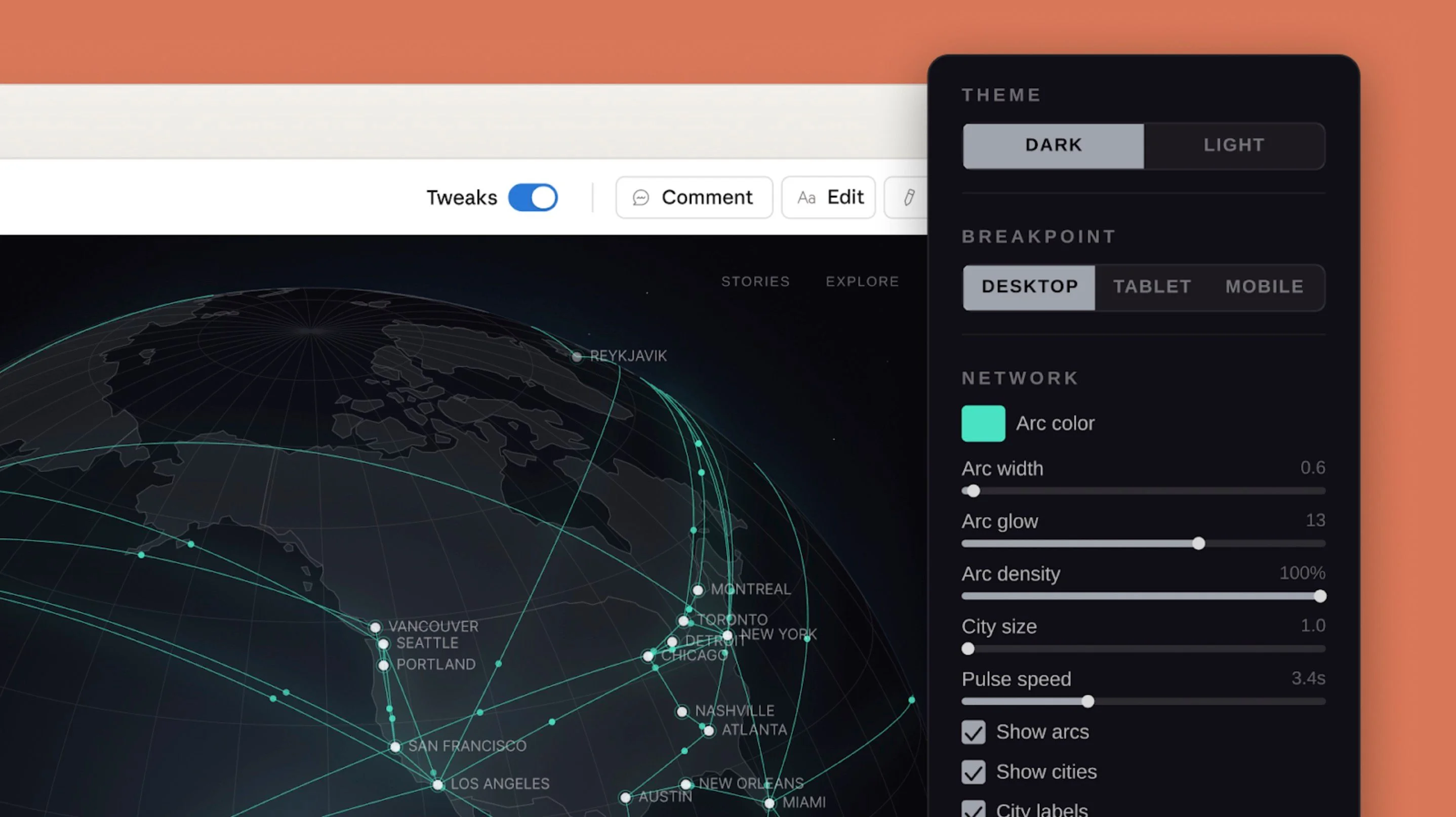
You build from there. Prompt to prototype. When the prototype is ready, one instruction passes it to Claude Code, which also reads your codebase. The loop closes: idea, design, production code, no translation step.
Lovable and v0 aim at different outputs. Lovable gives a greenfield founder a new app. v0 gives a developer a component to paste in. Claude Design gives a team with an existing product something pre-fitted to their repo. [5]
Why Does Starting From Your Codebase Matter?
Different starting points serve different people.
- Figma treats the design file as the canonical home for a brand. For design teams, that is still true.
- Claude Design treats the repo as canonical. That fits a different team: one where design intent already lives in Tailwind tokens, CSS variables, and component names.
This matters most to one person: the engineer or PM extending a live product. Not building something new. Not exploring from a blank canvas. Extending what is already there, in a way that matches what is already there.
For that person, starting from the repo removes a translation step. The output is already shaped by the code it will land in. The other tools are not worse at this. They are aimed elsewhere.
I post breakdowns like this regularly on LinkedIn and Instagram. The angle is always what it means for builders, not what the press release says.
When Should You Use Each Tool?
Pick by the starting point that matches your job.
- Figma is the tool for design teams on a shared canvas. Pixel precision, component libraries, review workflows, handoff annotations. Claude Design does none of this. [5]
- Lovable is the tool when you have no product yet and want idea to deployed app without code. MVP, internal tool, first prototype. Claude Design is not for that.
- v0 is the tool when you need a React component fast and can edit code. Claude Design is not trying to replace that.
Claude Design is aimed at a specific step: you have a live product, a new feature to design, and you need something that already matches everything you built. Teams have always solved this with some combination of briefs, design exploration, review, handoff, and engineering interpretation. Claude Design compresses that into a conversation that starts from the repo. Whether that is the right trade depends on the team.
The broader pattern is familiar. Zuckerberg returning to the codebase after 20 years using Claude Code is the same story. So is Karpathy explaining AI workflows to people who do not write code. AI is not replacing the work. It is eliminating the translation layers between people who do different kinds of work.
One signal worth noting. Mike Krieger, Anthropic's CPO and Instagram co-founder, resigned from Figma's board on April 14, three days before Claude Design launched. He had joined less than a year earlier. The resignation was disclosed to the SEC the same day The Information reported Anthropic was building design tools. [6] The adjacency was close enough for the board seat to become untenable, even though the two products are aimed at different jobs.
The market read the adjacency in real time.
What Are Claude Design's Limitations Right Now?
Claude Design is a research preview as of April 2026. Real constraints worth knowing before you try it:
- No multiplayer. For a design team on a shared canvas, Figma still wins cleanly. [5]
- Token burn is heavy. Claude Design runs on Opus 4.7 and is metered separately from your chat and Claude Code usage. Pro is described as "quick explorations, one-off use." One user reported two design sessions consuming 58% of their weekly Pro allowance. [7] To use it regularly, you need Max.
- Prototyping-level output, not production polish. The design system extraction makes things brand-consistent, but it is not a replacement for a designer's eye on the final layer.
- Export options are practical but limited: PDF, PPTX, standalone HTML, Canva. [8] The HTML export is also how the Claude Code handoff closes the loop. Anthropic's own ecosystem, end to end.
A 5-Question Claude Design Readiness Check
Before you open it, ask these. If you answer yes to three or more, Claude Design fits your workflow today. If not, Figma, Lovable, or v0 is probably the better tool for the job.
- Do you already have a shipped product in a GitHub repo? Claude Design starts from code that exists. No repo, no extraction.
- Is your design system encoded in Tailwind config, CSS variables, or component names? That is what the extractor reads. Design tokens locked in a Figma file alone will not transfer.
- Are you extending an existing product rather than starting from zero? The tool's edge is fit to what is already there. For greenfield work, Lovable or v0 is closer to the job.
- Can one person own the design-to-code loop, or does it need multiplayer? No shared canvas. If three designers need to work on the same file, Figma still wins.
- Are you on Max, or willing to rate-limit yourself on Pro? Two sessions burned 58% of a weekly Pro allowance. Regular use needs Max.
Three or more yeses and the translation step this tool removes is a real one for you.
Key Takeaways
- Figma, Lovable, v0, and Claude Design pick different starting points. Different starting points, different jobs.
- Figma treats the design file as canonical. Claude Design treats the codebase as canonical. Neither is wrong; they suit different teams.
- Claude Design's design system extraction reads your Tailwind, CSS, and component names to generate on-brand output from the first prompt, without manual configuration.
- Each tool fits a different starting point: Figma for collaborative design work, Lovable for greenfield apps, v0 for quick components, Claude Design for extending an existing codebase.
- Token burn is real. Claude Design is metered separately. Pro is for one-off use. Regular use requires Max.
- Anthropic's CPO resigned from Figma's board three days before launch. Figma's stock dropped 5 to 7% on launch day, a read of the adjacency, not a verdict on either product.
Shipping something where this trade-off matters and want a second read on it? Get in touch. I reply to every thoughtful email.
I post builder-first takes on AI tooling on LinkedIn, X, and Instagram. The kind that skip the hype and go straight to what changes for people who ship. If that is useful, a follow goes a long way.
Footnotes
-
Lovable vs v0: Which AI Builder Is Better? nocode.mba [↩] [↩ [2]]
-
Set up your design system in Claude Design, Claude Help Center [↩]
-
Claude Design vs Lovable: live side-by-side comparison, YouTube [↩]
-
Claude Design vs Figma Make: 2026 AI Design Tool Comparison, eigent.ai [↩] [↩ [2]] [↩ [3]]
-
Anthropic CPO leaves Figma's board after reports he will offer a competing product, TechCrunch [↩]
-
Anthropic launches Claude Design AI tool for paid plans, Testing Catalog [↩]
The Simple Take
One email when something in AI or tech deserves more than a headline.
Not a digest. Not a roundup. The one idea that week, fully worked out.