Zuckerberg Is Writing Code Again. With Claude Code.
Mark Zuckerberg landed 3 diffs in Meta's monorepo last month, his first code in 20 years. He's using Claude Code CLI. One diff got 200+ approvals.
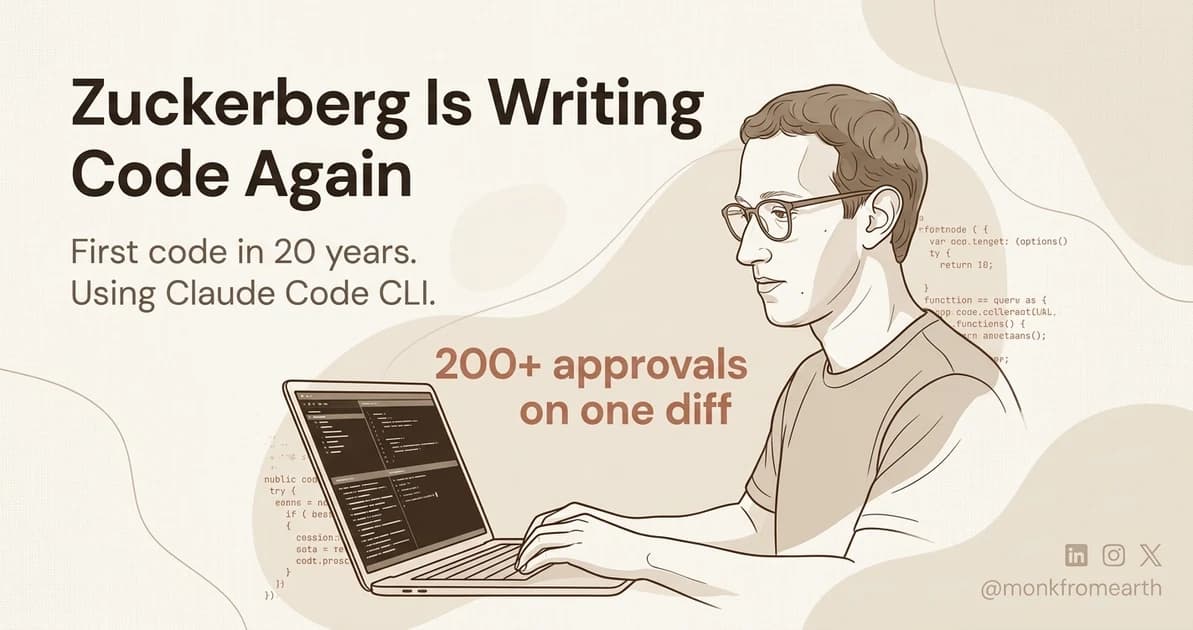
TL;DR: Mark Zuckerberg shipped 3 diffs to Meta's monorepo last month, his first code in 20 years. He's a heavy user of Claude Code CLI. One of his diffs got 200+ approvals from engineers who wanted to say they reviewed the CEO's code. He's not the only one. Garry Tan at Y Combinator is doing the same thing. The pattern is clear: AI coding tools are pulling founders back into the codebase.
What happened?
Gergely Orosz at The Pragmatic Engineer reported this week that Mark Zuckerberg is back to writing code. Three diffs landed in Meta's monorepo in March 2026. His tool of choice: Claude Code CLI, Anthropic's terminal-based AI coding assistant. [1]
To put the scale in perspective: Meta's monorepo now has close to 100 million diffs. Back in 2006, the entire Facebook codebase had fewer than 10,000. [1]
Zuckerberg's last meaningful code contributions were in 2006. That's a 20-year gap. The fact that he's back, and using an AI tool to do it, says something about where we are.
The 2010 diff that got force-merged
This isn't Zuckerberg's first time making waves in code review.
In 2010, he submitted a diff that made profile photos clickable on the profile page. Michael Novati, a senior engineer who would become the first person to hold Meta's L7 "coding machine" archetype, blocked it. The reason: formatting issues everywhere. [1] [2]
Zuckerberg overrode the block and force-merged it. [1]
Novati spent eight years at Meta and was recognized as the top code committer company-wide for several of them. The Pragmatic Engineer did a full episode with him about what it means to be a "coding machine" at that scale. [2]
The 2010 story is funny in hindsight. But the 2026 version is different. This time, Zuckerberg isn't force-merging past reviewers. He's using AI to write code that engineers actually want to approve. One of his March diffs got more than 200 approvals, with devs jumping at the chance to say they'd reviewed the CEO's work. [1]
Why this matters beyond the anecdote
Three diffs from the CEO of a 70,000-employee company is a footnote in a 100-million-diff monorepo. The signal isn't the code. It's the behavior.
Zuckerberg isn't the only founder pulled back into the codebase by AI tools. Garry Tan, CEO of Y Combinator, returned to coding after 15 years and open-sourced gstack, a Claude Code system with 23 specialist tools that turns the CLI into a virtual engineering team: code reviewer, QA lead, security auditor, release engineer. [3] [4]
Tobias Lütke, CEO of Shopify, has been running experiments with Karpathy's AutoResearch on internal company data. 37 experiments overnight. 19% performance gain.
I wrote about how AutoResearch works a few days ago. The throughline is the same: AI tools are collapsing the gap between "person with ideas" and "person who ships code." Founders used to be the first type. AI is turning them back into the second.
Meta's bet: AI writes most of the code
Zuckerberg coding again isn't a hobby. It's a signal of where Meta is heading.
Leaked internal documents from March 2026 show aggressive targets. Meta's creation org wants 65% of engineers writing 75% or more of their committed code using AI by mid-2026. The Scalable Machine Learning org set a target of 50-80% AI-assisted code. [5]
Zuckerberg himself said on Dwarkesh Patel's podcast that "in the next year, maybe half the development will be done by AI as opposed to people, and that will kind of increase from there." [6]
He's not predicting this from the sidelines. He's using Claude Code in the terminal to ship diffs to his own monorepo. The CEO is the pilot customer.
If you're tracking how AI is reshaping who gets to build, I'm writing about this every week on LinkedIn and breaking it down on Instagram as The Simple Take. A follow is the easiest way to catch the next one.
The pattern worth watching
There's a recurring shape here.
Karpathy builds AutoResearch. Constrains the agent to one file, one metric, one 5-minute cycle. The constraint is the invention. Lütke runs it on Shopify data overnight. Marketers adapt it for landing pages.
Anthropic builds Claude Code. Tan wraps it in 23 specialist agents. Zuckerberg uses it to ship his first code in 20 years.
The tools don't just help engineers code faster. They re-open coding to people who stopped. Founders who moved into strategy, management, fundraising. People who haven't touched a codebase in a decade. The barrier to re-entry used to be months of catching up on tooling, frameworks, and conventions. Now it's a terminal and a prompt.
That's a different kind of disruption than "AI replaces developers." It's closer to: AI brings back the builder-CEO. The person who can see a problem, describe a solution, and ship it before the meeting ends.
Whether Zuckerberg's 3 diffs were good code is beside the point. The 200 engineers who approved them probably weren't reviewing for correctness. But the fact that a CEO can sit down with Claude Code and produce something that compiles, passes CI, and lands in a 100-million-diff monorepo? That's the new baseline.
Key takeaways
- Zuckerberg shipped 3 diffs to Meta's monorepo in March 2026, his first code in ~20 years, using Claude Code CLI
- One diff got 200+ approvals from engineers eager to review the CEO's code
- Garry Tan (Y Combinator) also returned to coding after 15 years, open-sourcing gstack for Claude Code
- Meta targets 65-75% AI-assisted code across engineering by mid-2026
- AI coding tools are pulling founders back into codebases they left years ago
- The disruption isn't "AI replaces developers," it's "AI re-opens development" to people who stopped
If you work in or around engineering, the shift this post describes is going to reshape what "being a coder" means over the next 18 months. I write about this beat every week.
- LinkedIn: longer takes on AI, engineering, and where the builder-CEO is going next
- X: real-time notes as the story unfolds
- Instagram: The Simple Take, one idea simplified daily
Would appreciate a follow on any of them if this resonated.
Footnotes
-
The Pulse: Industry leaders return to coding with AI — The Pragmatic Engineer [↩] [↩ [2]] [↩ [3]] [↩ [4]] [↩ [5]]
-
"The Coding Machine" at Meta with Michael Novati — The Pragmatic Engineer [↩] [↩ [2]]
-
Why Garry Tan's Claude Code setup has gotten so much love, and hate — TechCrunch [↩]
-
How aggressive is Mark Zuckerberg's 'AI-native' push for Meta? — The Week [↩]
-
Mark Zuckerberg — AI will write most Meta code in 18 months — Dwarkesh Patel [↩]
The Simple Take
One email when something in AI or tech deserves more than a headline.
Not a digest. Not a roundup. The one idea that week, fully worked out.
Related