Good Products Are Hard to Vary
What a tyre, an iPhone, and a line of poetry have in common. Not good design. They're impossible to improve without making them worse.
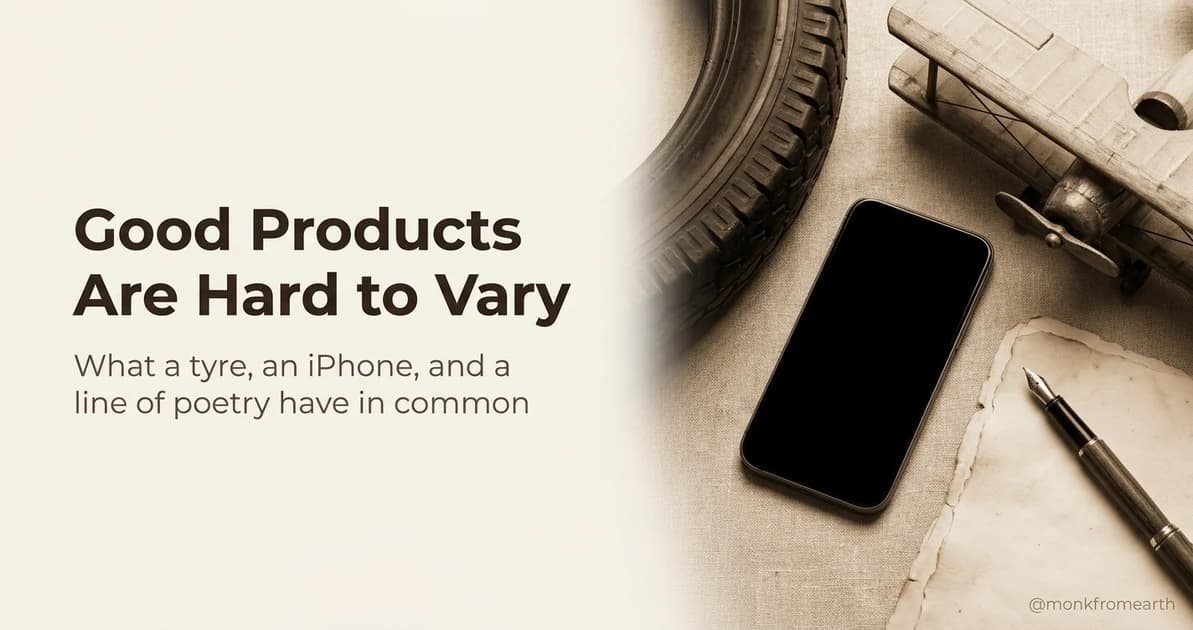
I keep noticing things that have stopped changing. Not abandoned, not forgotten. They feel finished, in a way that most things never do. The tyre on your car looks exactly like the one your grandfather drove on. The phone in your pocket has been the same rectangle since 2017. And there are lines of poetry, written centuries ago, where you couldn't move a single word without the whole thing falling apart.
I wanted to understand why. What I found was stranger than I expected.
Sixteen Years, Same Phone
What does that tell you?
The iPhone hasn't changed since the X. Edge-to-edge glass, no home button, Face ID. Every generation since has been a camera upgrade, a chip bump, a new color. The shape stayed. Nearly a decade of the same rectangle, and nobody at Apple seems bothered by that.
A tyre hasn't changed in over a century. Rubber, air, round. You'd think someone, somewhere, would have found something better by now. Nobody has. Not for lack of trying.
The easy explanation is good design. Apple's team nailed it. Whoever made the first pneumatic tyre nailed it. Smart people, solved problems, nothing left to improve.
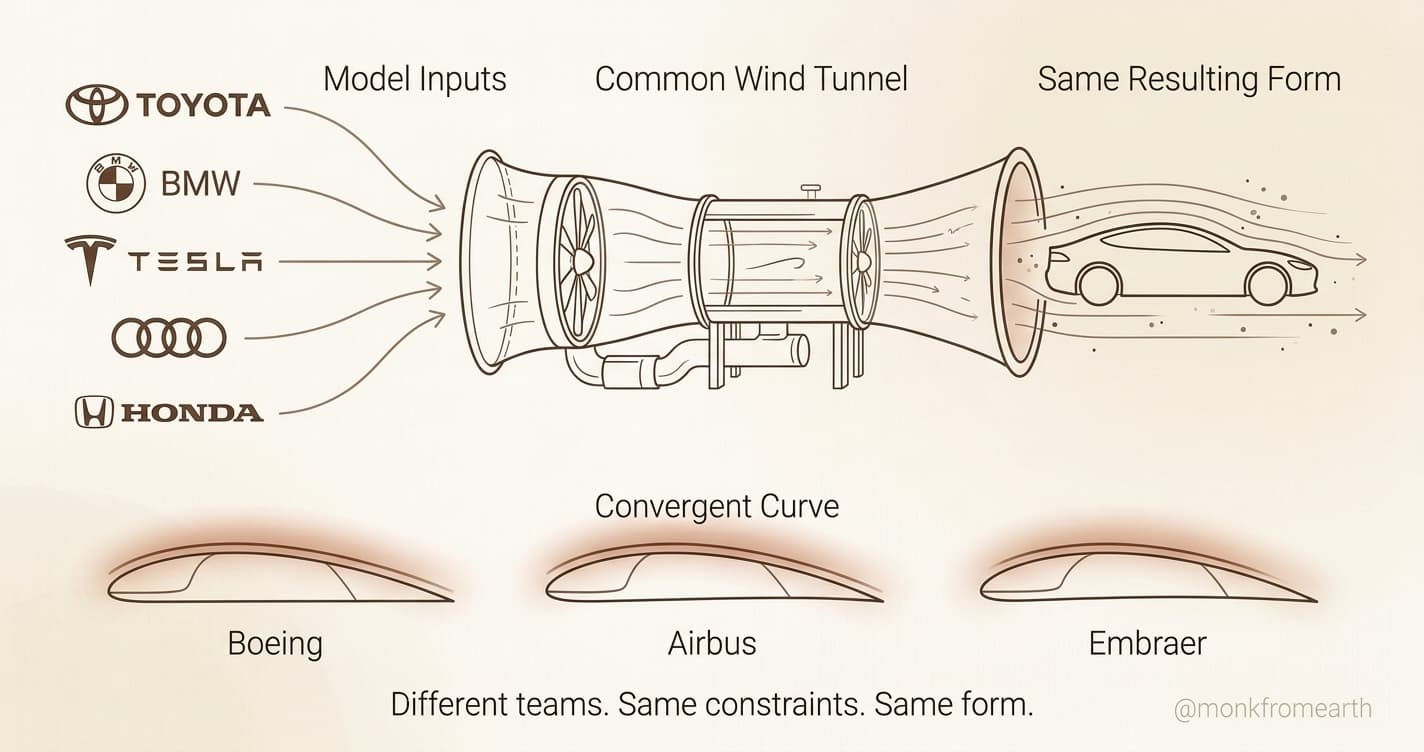
But then you start noticing something odd. All modern cars look the same. Not because anyone copied anyone, but because they all went through the same wind tunnels. All commercial airplane wings converge on the same curve, independently, across manufacturers who've never spoken to each other. Saint-Exupery, who was a pilot before he was a writer, put it this way: "Perfection is achieved, not when there is nothing more to add, but when there is nothing left to take away." [1]
If this were just good design, you'd expect variety. Different teams, different sensibilities, different answers. Instead you get convergence. Everything quietly arriving at the same form.
That's not design. Something else is happening.
The Convergence
Good products are hard to vary
David Deutsch proposed a principle in The Beginning of Infinity: good explanations are hard to vary. [2] Every component in a good explanation does necessary work. Swap anything out and the whole thing breaks. Naval Ravikant applied this to products. [3] A good product is one where every element is load-bearing. The iPhone's form. The tyre's shape. The wing's curve. Try to vary them and you don't get a different good product. You get a worse one.
Robert Frost, 1916:
Two roads diverged in a wood, and I— I took the one less traveled by, And that has made all the difference. [4]
What would you even remove? The repeated "I"? That hesitation is the poem. The comma after "by"? That pause is where all the weight sits. Every word, every break, every breath in those three lines is structural. Change one element and the poem doesn't get worse. It becomes a different, lesser thing.
A car shaped by wind tunnels and a poem shaped by meter arrived at the same place through completely different paths. A form where nothing can be varied without loss. Not because someone sat down and designed perfection. Because constraints, over time, eliminated everything else.
Baby Shoes, Never Worn
What density really means
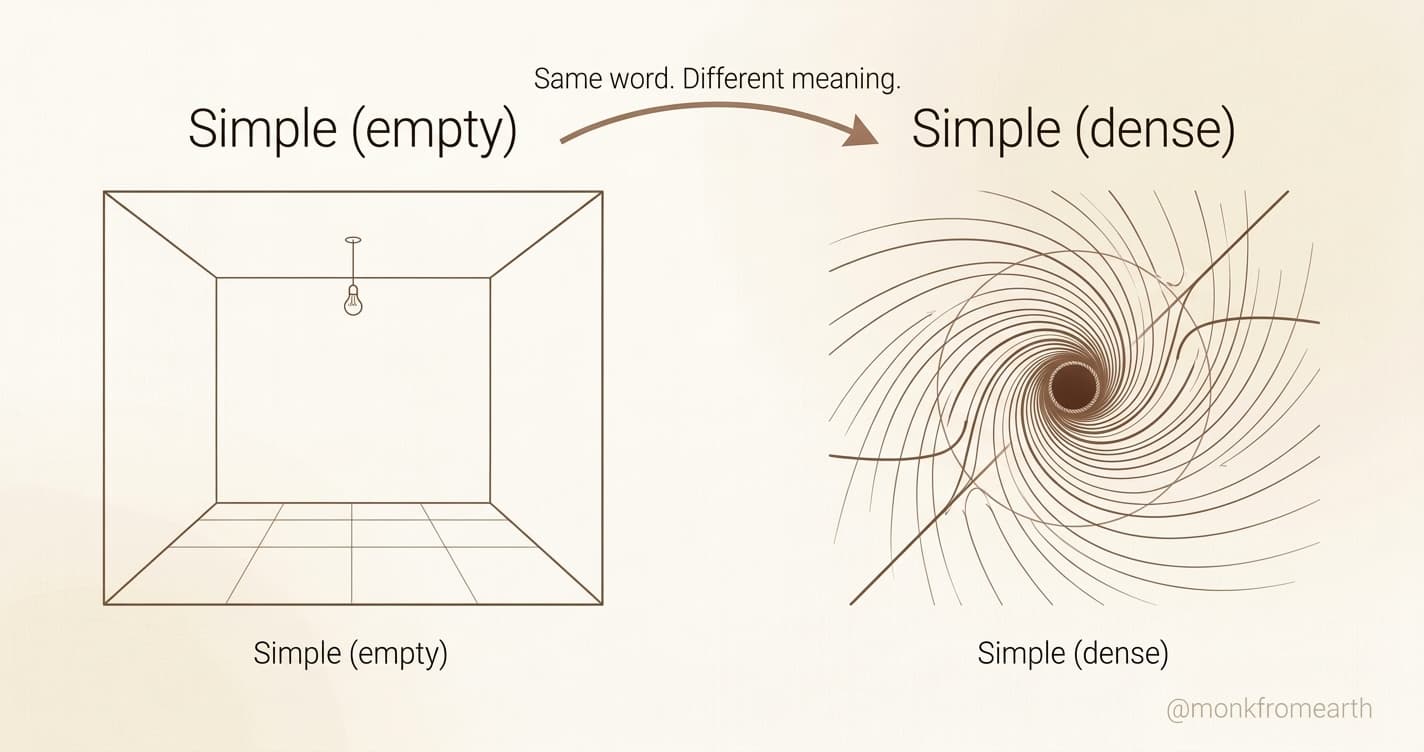
Density, not simplicity, is the real measure here. These things aren't simple the way an empty room is simple. They're simple the way a black hole is simple: enormous meaning compressed into the smallest possible form.
A tyre isn't simple because it lacks complexity. It's simple because everything that isn't rubber, air, and round has been stripped away over a century of people trying other things. What remains is only what's necessary.
"For sale: baby shoes, never worn." Often credited to Hemingway, almost certainly wrongly. [5] An entire life implied in the space between "baby shoes" and "never worn." Can't take a word out. Can't put one in.
Jaun Elia wrote: "Mujhse milne aayein hain, baithiye, bula kar laata huun." [6]
You've come to meet me? Sit. Let me go find myself.
The grief lives entirely in that last phrase. Swap it for anything else that fits the meter, and the sher doesn't weaken. It stops being a sher at all.
A tyre. A story. A sher. What survives in each is only what's load-bearing. And what's load-bearing cannot be moved.
The Invisible Drafts
Evolution doesn't publish release notes
None of this happened overnight. That's the part we tend to forget.
Matt Ridley argues in The Evolution of Everything that nearly all design is bottom-up. [7] No master planner. No grand blueprint. Just variation under pressure, repeated across time, with the failures quietly removed. What survives is what couldn't be improved by changing it. Not because someone decided it was finished, but because nothing better made it through the filter.
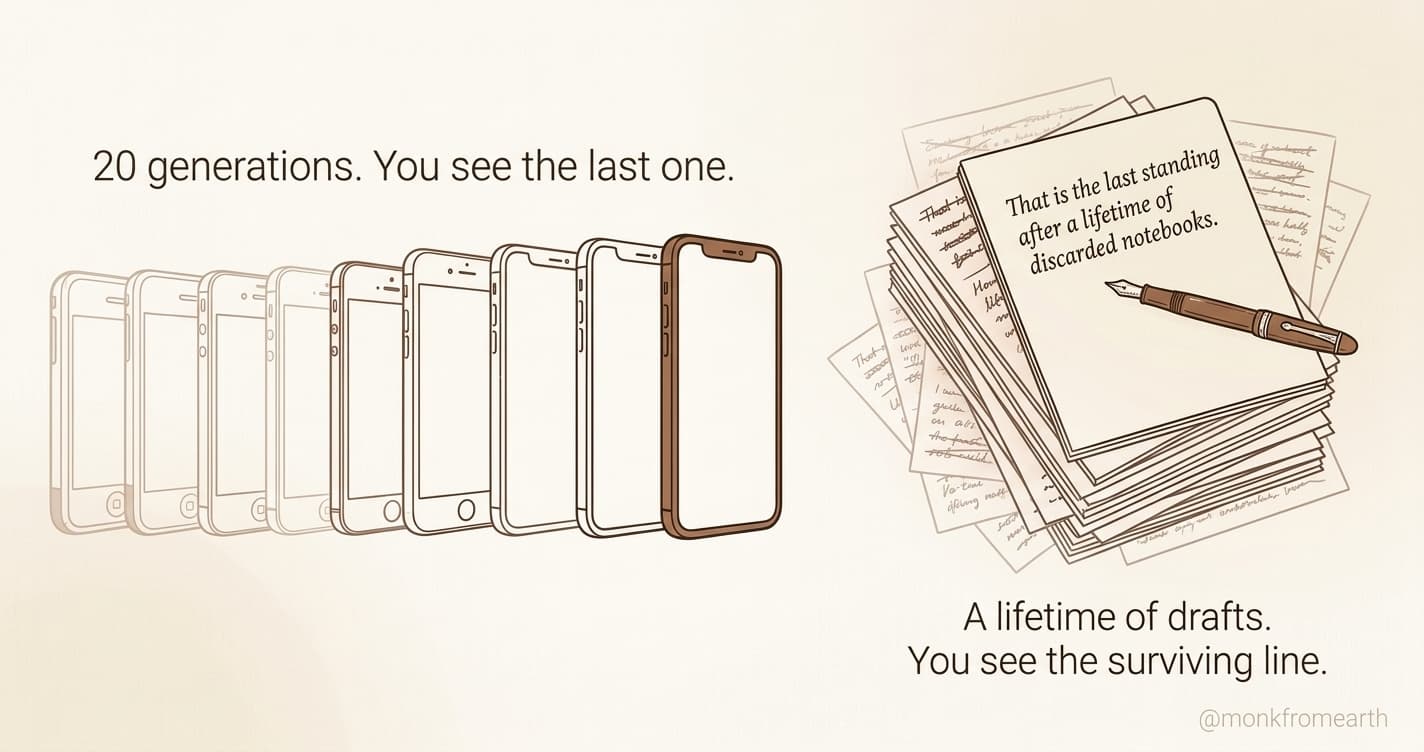
The iPhone you hold today is the survivor of nearly twenty generations. Each one slightly closer to the form that resists variation. You see the one that lived. You don't see the thousands of prototypes, the rejected curves, the abandoned features that didn't make it past internal review.
A sher that people quote a century later is not the poet's first attempt. It's the last one standing after a lifetime of discarded notebooks. The iteration happened. You just never saw it.
"Jahaan aap pahuchein chalaangein laga kar, wahaan mai pahucha magar dheere dheere." [8] Where you arrived by leaping, I arrived too. But slowly. Same destination. One path looks like a breakthrough. The other looks like nothing happened at all.
Patience, it turns out, is a design principle.
What Can't Go Home
A new species, not a better version
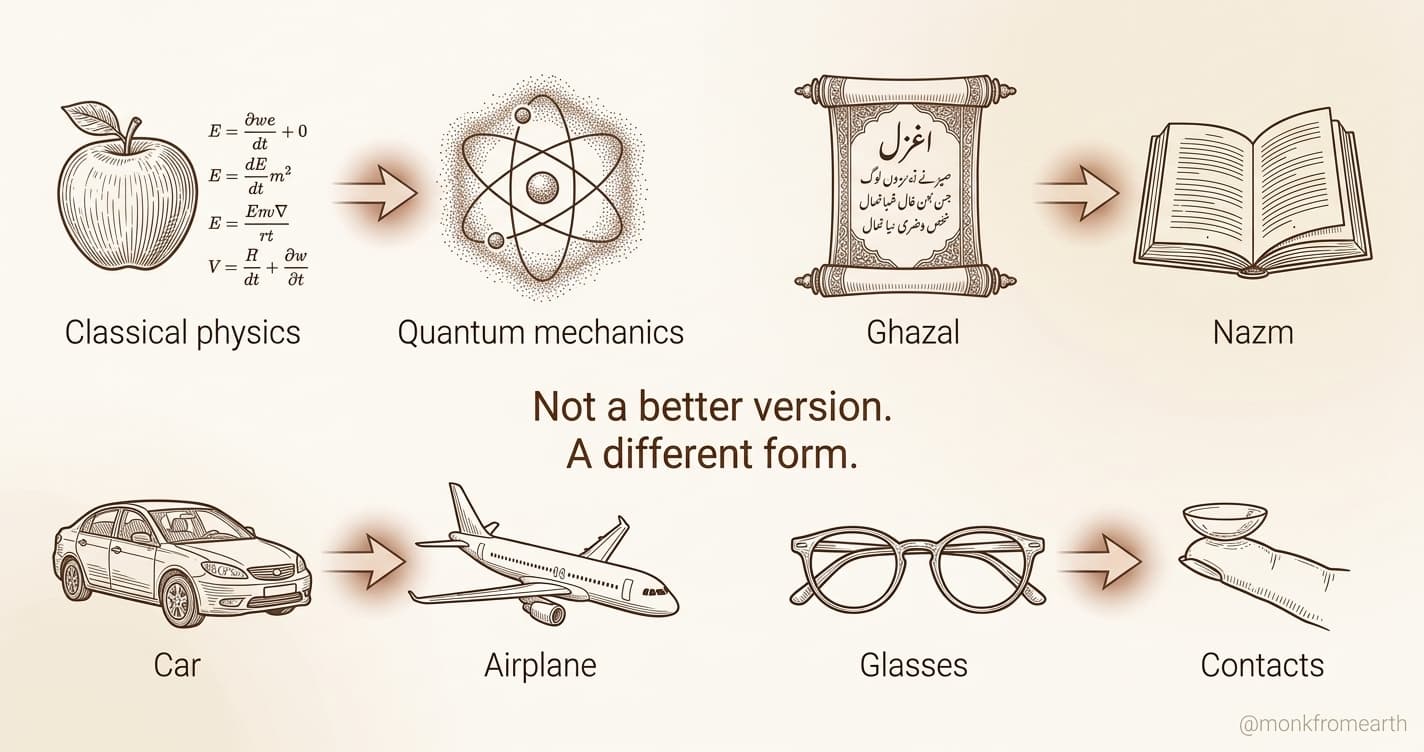
When constraints have squeezed out all variation, the form freezes. And the energy that can't fit inside it anymore spills into something entirely new.
Classical physics was, for two centuries, the most successful framework humans had produced. Newton's equations predicted falling apples and planetary orbits alike. The form looked complete, perfected within its constraints. Then someone looked at the very small, and the equations broke. Quantum mechanics wasn't a better version of classical physics. It was a different form altogether. Newton still works perfectly for rockets and bridges. But the new physics couldn't fit inside the old framework. It had to leave home.
The ghazal was perfected over centuries. Fixed meter, mandatory rhyme scheme, a repeating refrain called the radif. When poets needed to say things those constraints couldn't hold, they didn't write better ghazals. They created nazm, a different vessel entirely.
Cars perfected ground travel. Airplanes didn't improve the car. They solved the problem the car revealed: I can go anywhere, but not fast enough. Glasses perfected vision correction. Contact lenses didn't make better glasses. They eliminated the frame.
In biology, this is speciation. A population drifts far enough from its parent that it can no longer return. Not a better version of the old one. A different organism, solving a related problem.
Perfection in one form isn't an ending. It's a signal. The next breakthrough won't be an improvement. It'll be a departure.
The Last Form
Was never simple to begin with
A tyre. Round, black, ordinary. Your phone. Glass, pocket-sized. Frost's last line. "And that has made all the difference."
They feel obvious now. Like they couldn't have been any other way.
They couldn't. Not because someone designed them that way, but because constraints, applied patiently over time, eliminated every other possibility. What remains isn't simple. It's dense. Every element load-bearing. Nothing left to vary.
Making simple things is hard. Constraints get us there. And when they finally do, when a form can't be varied anymore, that's not the end of the story. It's the beginning of the next one.
Further Reading
Lines that embody the same idea. Dense. Hard to vary.
- Ramdarath Mishr: "Kisi ko giraaya na khud ko uchaala, kata zindagi ka safar dheere dheere / Jahaan aap pahuchein chalaangein laga kar, wahaan mai pahucha magar dheere dheere"
- Unknown: "Tumhaara khoobsurat hona nahi, tumhaara hona khoobsurat tha" — same words rearranged. The inversion carries everything.
- Mujahid: "Aap ne dekh to li hi hongi, aap ko dekhti hui aankhein"
I break down things like this on LinkedIn, X, and Instagram. If this resonated, you'd probably like those too.
Footnotes
-
Antoine de Saint-Exupery, Wind, Sand and Stars (1939). On the evolution of airplane design. [↩]
-
David Deutsch, The Beginning of Infinity (2011). Chapter 1: the "hard to vary" criterion for good explanations. [↩]
-
Naval Ravikant, "Good Products Are Hard to Vary". Deutsch's principle applied to product design. [↩]
-
Robert Frost, "The Road Not Taken" (1916). [↩]
-
The six-word story is widely attributed to Hemingway, but versions appeared in print as early as 1906, when Hemingway was seven. [↩]
-
Jaun Elia (1931-2002), among the most influential modern Urdu poets. Existential themes, deceptive simplicity. [↩]
-
Matt Ridley, The Evolution of Everything (2015). Bottom-up evolution, not top-down design, across every domain. [↩]
-
Ramdarath Mishr. The full couplet is in Further Reading. [↩]
The Simple Take
One email when something in AI or tech deserves more than a headline.
Not a digest. Not a roundup. The one idea that week, fully worked out.