The Microsoft-OpenAI AGI Clause Is Dead. What Was It Doing?
For seven years, an AGI declaration would have voided Microsoft's rights to OpenAI's tech. On April 27, 2026, that clause quietly died. Here's why.
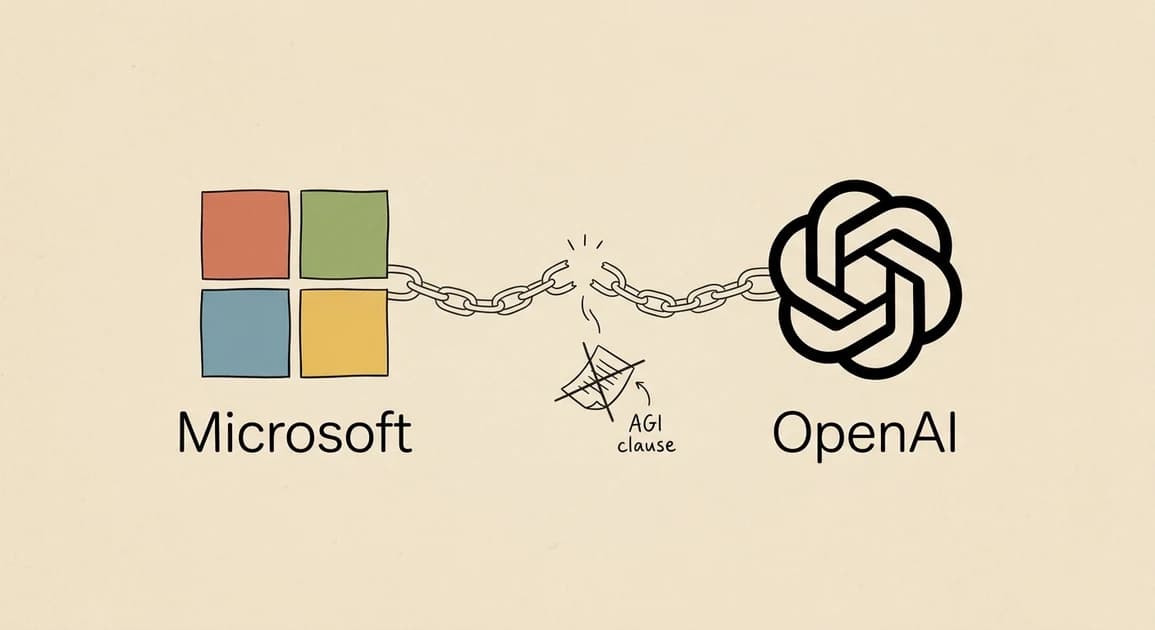
On April 27, 2026, Microsoft and OpenAI quietly removed the trigger that would have voided their entire deal. [1] [2] The press release called it "simplification." What it actually did was bury the AGI clause without naming it.
TL;DR: For seven years, an AGI declaration by OpenAI's board would have nullified Microsoft's commercial IP rights. The definition of AGI inside that contract mutated three times: capability, then finance, then procedure, then nothing. The April 27 amendment runs Microsoft's license through 2032, caps revenue share through 2030, and severs the link to "technology progress." AGI did not get redefined. It got demoted.
What Was The AGI Clause?
The original 2019 contract licensed Microsoft to "pre-AGI technologies" only. [3] If OpenAI's board ever declared AGI achieved, Microsoft's commercial rights became null and void.
That made AGI the load-bearing word in the entire deal. It defined:
- What Microsoft was buying: access until AGI.
- What OpenAI was promising: to surface that moment publicly.
- What would dissolve the relationship: the declaration itself.
A trigger, not a goal. That is what the clause actually was.
How AGI Mutated Inside The Contract
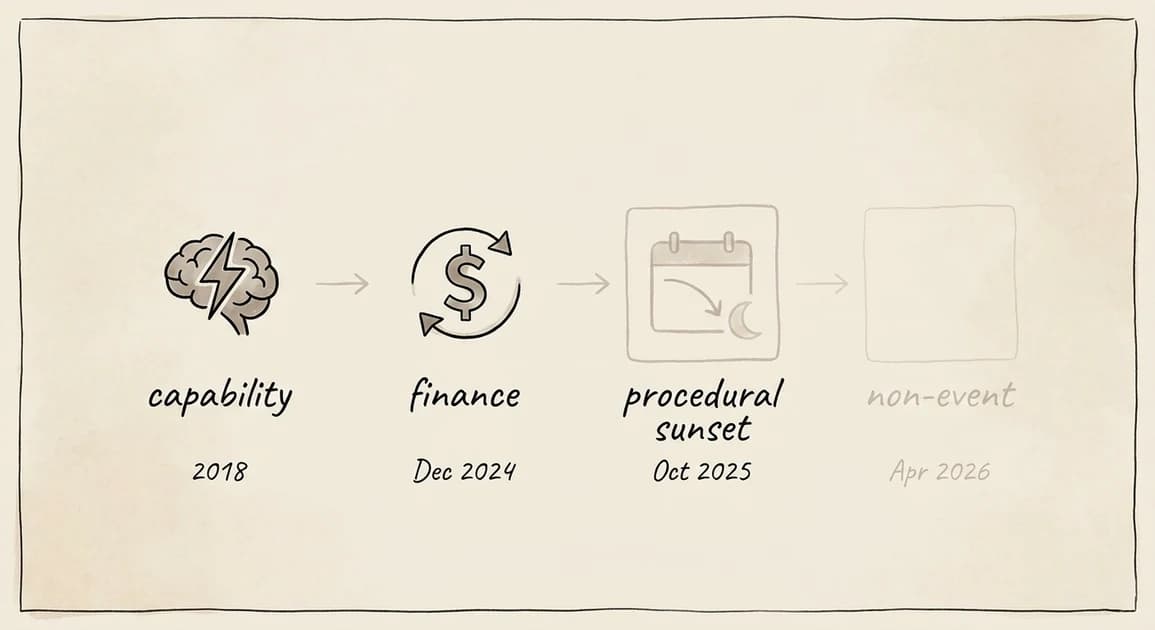
The trigger kept getting softer. Watch how the definition changed:
- April 2018 (OpenAI Charter): AGI as capability. "Highly autonomous systems that outperform humans at most economically valuable work." [4]
- December 2024: AGI as a financial threshold. Roughly $100 billion in profit. [3]
- October 2025: AGI as a procedural sunset. "Independent expert panel" verification, or 2030, whichever came first. [3]
- April 27, 2026: AGI removed from contract logic entirely. Revenue share runs "independent of OpenAI's technology progress." [2]
Each redefinition stripped meaning until the concept stopped doing legal work.
AGI didn't get redefined. It got demoted, from a destination to a milestone to a non-event.
Why The Clause Existed In The First Place
David Deutsch's frame for what makes a good explanation is hard to vary: every part is load-bearing, change anything and it breaks. [5]
The original clause passed that test. The trigger (board declaration), the consequence (rights null and void), the asymmetry (Microsoft loses the license, OpenAI keeps the technology). Each piece did real work.
It was a hedge against the success case. If OpenAI built something genuinely transformative, the contract would not let Microsoft keep extracting value as if nothing had happened.
By 2025, every part of that insurance was being separately renegotiated. That is the sign an explanation has stopped explaining.
What April 27 Actually Changed
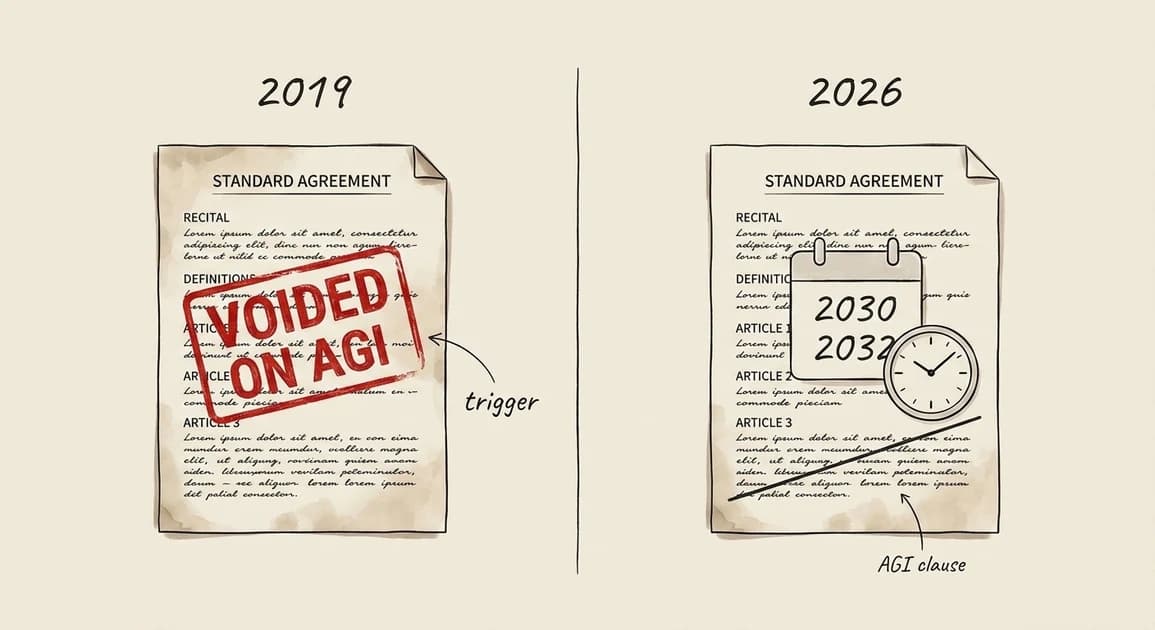
The amended agreement, in plain commercial terms: [2]
- Microsoft's license to OpenAI IP runs through 2032 and is non-exclusive for the first time.
- OpenAI can serve products to customers across any cloud provider. Microsoft remains primary; OpenAI ships first on Azure unless Microsoft cannot or chooses not to support the workload.
- Revenue share from OpenAI to Microsoft continues through 2030 at the same percentage, capped, independent of technology progress.
- Microsoft will no longer pay revenue share to OpenAI. Cash flow is now one direction.
- Microsoft remains a major shareholder.
This is a normal commercial agreement. Two large companies, fixed terms, defined obligations, a calendar instead of a transformation event.
What the deal does not say is louder than what it does. Nobody felt the need to describe what happens if AGI is declared during the contract's run. Neither side wanted to be the party that re-introduced the question.
The relationship used to be defined by what would end it. Now it's defined by what it pays.
Who Wins, Who Pays
| Party | What they got | What they gave up |
|---|---|---|
| OpenAI | Right to serve customers on any cloud, non-exclusive license partner | Revenue share to Microsoft through 2030 |
| Microsoft | Capped, fixed-term annuity + license through 2032 | The contingent upside of the AGI clause |
| OpenAI workloads now reachable on Google Cloud | Nothing | |
| Anthropic | Indirect: AGI no longer the planning unit at the top of the market | Nothing |
OpenAI's biggest gain is commercial freedom, not infrastructure freedom. The right to sell into channels Microsoft does not own. Microsoft trades a theoretical upside for a guaranteed cash flow. Google sells compute to both frontier labs without picking sides.
What Replaces AGI As The Planning Concept
Read the deal twice and the answer is plain: license duration and capped revenue.
Microsoft's IP rights through 2032. Revenue share from OpenAI through 2030, with a cap. Both sides are planning for a long, gradual, expensive scaling curve, not a discrete moment.
This matches every other 2026 infrastructure deal:
- Google's $40B Anthropic investment is a cloud commitment dressed as equity, similar to how Google's TPU 8 split training from inference was an infrastructure repositioning, not a chip launch. [6]
- DeepSeek V4's 1M context release expanded design space without anyone calling it transformative.
- Apple's elevation of a hardware engineer to CEO is a bet on a long inference era, not a discontinuity.
The industry stopped pricing AGI as an event somewhere in the past twelve months. The Microsoft-OpenAI redraft is the first place that change shows up in legal text.
What To Watch Next
The next signal will not come from anyone's blog post. It will come from contracts.
- Anthropic-Google paperwork: does it carry AGI language?
- Apple's emerging AI-licensing terms: any trigger clauses?
- EU sovereign AI agreements: does the word survive in any active commercial role?
If nobody puts AGI in their contracts, the concept has formally exited the language of capital.
A clause that stops doing legal work stops being a clause. It becomes ceremony.
April 27 was not the day Microsoft and OpenAI gave up on AGI. It was the day they admitted it had stopped paying rent.
Key Takeaways
- The original 2019 AGI clause would have voided Microsoft's commercial IP rights to OpenAI's technology upon a board AGI declaration.
- The definition mutated three times: capability (2018) → financial threshold (Dec 2024) → procedural sunset (Oct 2025) → removed (April 2026).
- The new deal: Microsoft license through 2032 (non-exclusive), revenue share to Microsoft through 2030 (capped, no AGI link), OpenAI free to serve any cloud.
- OpenAI's biggest gain is commercial freedom, not infrastructure freedom.
- The death of the clause is the first place in legal text where the industry treats AGI as a long inference curve, not an event.
Footnotes
-
Simon Willison: "The now-deceased AGI clause" , April 27, 2026. [↩]
-
OpenAI and Microsoft: "The next phase of the Microsoft OpenAI partnership" , April 27, 2026. All amended-agreement bullets cited from this announcement. [↩] [↩ [2]] [↩ [3]]
-
AGI definition history per Willison's reporting and prior coverage of Microsoft-OpenAI contract revisions, 2018-2025. [↩] [↩ [2]] [↩ [3]]
-
OpenAI Charter , published April 9, 2018. [↩]
-
David Deutsch, The Beginning of Infinity, 2011 , "hard to vary" as the test of a good explanation. [↩]
-
TechCrunch: "Google to invest up to $40B in Anthropic" , April 24, 2026. [↩]
The Simple Take
One email when something in AI or tech deserves more than a headline.
Not a digest. Not a roundup. The one idea that week, fully worked out.
Related