47 Jev use cases: real demos, reported results and ideas worth testing
Explore 47 Jev applications across documents, agents, search, games and business workflows, with original sources, reported costs and clear caveats.

Start with the 45-second video
Matija Sošić explains the idea in the original video below. Watch on X if the player does not load.
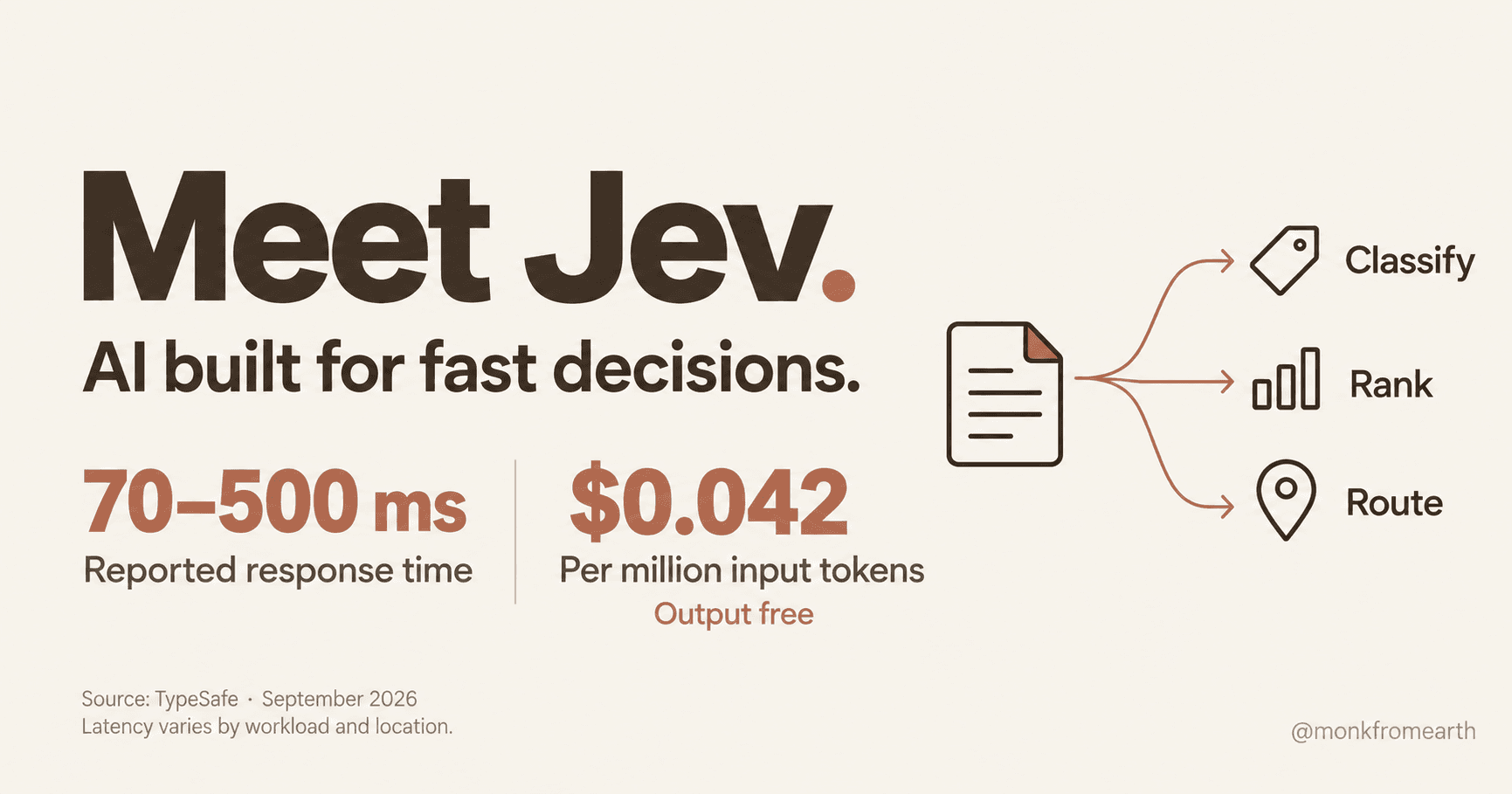
An AI model that chooses labels can end up inside a phone controller, a search engine or a game. What changes is the work surrounding each decision.
That is what makes Jev's first wave of applications interesting. The screenshots look unrelated, but underneath them are questions such as “Which record matters?”, “What should happen next?” and “Does this need a more expensive check?”
This guide collects 47 workflows from the September 2026 research, with related industry ideas grouped together. It is a menu for choosing experiments, not a claim that 47 products have proved themselves in production. For the model's interface, pricing and limitations, start with the Jev explainer.
How to read the evidence: a reported result is a builder's measurement I have not rerun; an implementation has inspectable code; a demo shows a specific path; a cookbook is a documented example; a proposal remains an idea. Some entries have more than one label. Sources are attached so you can inspect the original work.
Business records and documents
1. Reclassify an old business archive
Reported result. Zac Gawn reports sorting 20,000 emails, Slack messages and transcripts in seven minutes for $1.45. Categories include complaints, upsells and missed follow-ups. The useful pattern is asking new questions of old records when a business changes. Accuracy and the complete cost breakdown are not published. Original post.
2. Route documents and attach useful metadata
Demo. Aaron Levie shows a Box workflow assessing an incident report's severity and customer impact, then choosing an escalation, monitoring or review destination. Jev provides judgments; Box operations move the file and attach metadata. No comparative latency or accuracy study accompanies the post. Aaron Levie's demonstration.
3. Send only necessary pages to OCR
Implementation and reported result. In doc-router's 155-page test, billed pages fell from 155 to 87, time from 35.578 to 20.666 seconds, and cost from $0.3100 to $0.1783. The routed path missed nine pages needing OCR. That trade-off must be evaluated before adopting the savings. Repository and method.
4. Identify tax forms before processing them
Implementation and reported result. Kyoto's classifier covers a registry of 261 federal forms. Its pipeline comparison reports approximately $0.039 → $0.00115 per page and 3.3 → 0.5 seconds warm latency. Although no wrong labels were reported on the cited corpora, 38 of 753 blank-form pages failed the strict confidence gate. Scans need separate OCR. Code and evaluation.
5. Check a cheap extractor before paying for a stronger one
Cookbook. Let a generative model extract fields, then ask Jev about specific failure conditions. Cases that fail go to a stronger model. This is useful when an output can be correctly formatted but unsupported by the document. The fallback's quality and cost remain part of the system. Extraction cascade.
6. Choose the relevant amount, address or phone number
Cookbook. Code first collects candidate values from a document; Jev selects the one matching the request. Code copies the original value instead of asking the model to write it. This works only if the candidate finder included the right value. Pre-parsed value selection.
7. Recover dates without outsourcing calendar arithmetic
Cookbook. Jev can select date components and identify missing information. Code then checks calendar validity, resolves relative dates and performs comparisons. A document's “next Friday” needs a reference date; a plausible-looking date is insufficient. Date extraction.
8. Rebuild a document's structure
Cookbook. Decide which lines belong together and which blocks are headings, paragraphs or lists. Ordinary code then renders the selected structure into Markdown. The cookbook demonstrates a pattern, but its printed cost figures need reconciliation, so they should not become a savings claim. Structure recovery.
9. Classify items inside a large taxonomy
Cookbook. Products, patents and source files may belong to categories nested several levels deep. Multiple smaller choices can navigate that hierarchy, keeping promising branches open. A large catalog therefore need not fit inside one question's allowed options. Hierarchical classification.
10. Return a broader category when the precise one is uncertain
Cookbook. A company record might support an industry family without supporting a narrow subcategory. Confidence can help the application choose the level of specificity it returns. That behavior still requires validation; broader answers are not automatically correct. Confidence-based classification.
Search, knowledge and retrieval
11. Reorder search results by meaning
Builder report. Ian Nuttall reports testing Jev on Keep.md with 7× faster reranking than his existing hybrid approach. Reranking means reordering an already retrieved candidate list. The post does not establish equivalent relevance quality, sample size or latency percentiles. Original report.
12. Tag incoming content
Builder report. The same Keep.md post reports 50× faster content tagging than GLM 4.7 Flash. Tags can make later filtering and organization easier. The author's “no failures” wording does not establish perfect label accuracy, and this comparison has a different baseline from the search result. Tagging report.
13. Filter retrieved passages before generating an answer
Cookbook. Evaluate whether passages are relevant, contradict a claim or contain instructions aimed at the assistant. Pass the appropriate evidence onward. Contrary evidence may be exactly what an answer needs, so contradiction should not automatically mean deletion. Retrieval filtering.
14. Check whether a citation supports its claim
Cookbook. First verify in code that quoted text exists. Then judge whether its surrounding context supports the proposed claim. These checks catch different problems: a real quote can still be misleadingly used. The judgment is another check to evaluate, not an infallible fact-checker. Citation checking.
15. Find an answer-bearing line and return it verbatim
Cookbook. Jev selects a line identifier and checks whether the source contains an answer. Code returns the referenced text. This preserves the original wording while allowing a semantic search, but an empty or unsuitable source must remain an acceptable outcome. Semantic line search.
16. Organize a personal knowledge base
Proposal. Classify notes, match topics and flag possible duplicates before storing or recalling them. Shann Holmberg proposes this “second brain” pattern. Actual storage success still needs a file or database check; the model deciding that a note should be saved does not prove it was saved. Original proposals.
17. Match records across databases
Cookbook. Evaluate candidate record pairs and choose merge, review or leave unlinked. The official example uses 450 beer-catalog pairs. This is useful for duplicate catalogs and knowledge-graph enrichment, provided ambiguous matches can reach review rather than being silently merged. Entity alignment.
18. Add semantic filters to SQL queries
Implementation. pg-jev exposes decisions about row content through PostgreSQL functions: relevance probabilities, categories and rubric scores. SQL still handles exact operations and joins. The model call adds a network-dependent judgment, so this should be compared with ordinary filters and indexes for the actual workload. pg-jev.
AI agents and software operations
19. Select an agent's useful memories
Offline reported result. Aera's unattended-case comparison reduced median selection time from 463 to 147 ms and cost from $0.00028 to $0.00017, while matching coverage and improving precision. It used one working profile and automated evaluation, not a shipped integration. Study and limitations.
20. Prune an agent's growing context
Implementation. fast-jev-compaction asks which parts of a session should survive, preserving retained text rather than rewriting it. Dropped or truncated material is still lost. The implementation can use several concurrent requests, and its README animation is explicitly scripted rather than API-backed. Repository.
21. Watch a coding agent's progress
Architectural experiment. Foreman runs an observation loop around one coding worker. Jev assessments help identify progress, getting stuck or needing intervention; Python policy determines the response. This makes supervision inspectable, but the repository does not establish better outcomes than a conventional agent setup. Foreman, Josh Rosen's explanation.
22. Triage a pull request before detailed review
Builder report. Paolo Rosson describes 14 checks across six PRs, costing approximately $0.00007 per PR, with roughly half-second decisions. Checks cover risks such as secrets, authentication changes and broken APIs. This can prioritize human review; it does not establish security coverage or justify automatic merging. Original post.
23. Choose the model, specialist or escalation path
Proposals. A small decision can select an inexpensive model for a straightforward request, a specialist for a narrow task or a person for an ambiguous case. Related Puffle plans include memory retention, completion checks, error routing and whether to answer in public channels. These are proposed integrations, not measured deployments. Routing ideas, Puffle's plans.
24. Select which skills an agent should load
Cookbook. The official example starts with a 182-skill catalog, shortlists candidates and inspects the top three more closely. The purpose is to give an agent relevant instructions without loading everything. Include the possibility that none of the suggested skills fits. Skill selection.
25. Choose tools and bounded arguments
Cookbook and proposals. Select a permitted function, tool or query route, including whether to consult SQL, vector search or a graph. Closed-set arguments can be selected too. Free-form strings need extraction, supplied candidates or another generator; application code executes the call. Typed function calls, Agent patterns.
26. Check prompts, outputs and requested actions
Cookbook. Evaluate explicit hazards before the application proceeds. This can add a guardrail layer around another model, but a model reading hostile content is not a complete security boundary. Permissions, allowed operations and deterministic checks still belong outside the judgment. Guardrail examples.
27. Annotate logs and prioritize expensive analysis
Implementation. Jev Logs adds judgments to OpenTelemetry records and can route selected material into a separate analysis branch. The default annotation path preserves the records. The reviewed receiver is a local development preview, so it should not be described as an established production monitoring service. Jev Logs.
28. Decide what enters a semantic cache
Proposal. Judge whether a result is worth caching and choose from predefined expiration buckets. This could reduce repeated model work. Exact invalidation rules still need code, and a fast cached answer is harmful if the underlying information has changed. Cache and routing proposals.
Browsers, phones, homes and voice
29. Select browser actions
Demo and reported result. Browser Use's Google Flights example takes 7.073 seconds, with 178 ms median Jev request latency. Timing excludes setup, initial navigation and independent post-run verification. Structured page information drives decisions; a separate model generates text to type. It finds flights without booking them. Timing notes.
30. Operate an Android app
Demo. mobile-jev uses Jev decisions with Mobilerun device execution. The Uber route demonstration reaches payment selection in about 21 seconds across nine actions. It uses structured UI state, and it does not demonstrate a completed ride purchase. Device-service costs are separate from model charges. Mobile implementation.
31. Route smart-home requests
Implementation. HA-Jev connects decisions to Home Assistant entities and supported actions, including lights, device selection and reminders. Other software handles speech recognition and exact numeric parsing. The integration's existence does not establish safe reliability for consequential actions such as unlocking a door. Home Assistant integration.
32. Make decisions during a voice conversation
Proposals. After transcription or other signal processing, decide whether a turn is complete, whether an utterance interrupts or acknowledges, what the intent is, whether confirmation is needed and where to route it. Spoken-response checks and conversation-state transitions fit too. Jev itself does not recognize or synthesize audio. Voice workflow ideas.
Interfaces, games and simulated control
33. Compose an interface from an existing component catalog
Experimental implementation. Chris Tate's json-render work lets Jev select supplied components, content bindings and arrangements. Code builds and validates the resulting interface. The documented APIs were unreleased and required a source build at this check; arbitrary new copy or missing data is not invented by Jev. Original demo, Implementation guide.
34. Choose a game's terrain as it runs
Measured prototype. Sprite Fusion selects surface type, width, gaps and height, while game code places the terrain. The author reports five calls at 319–375 ms each, estimating $0.00057 per request and $0.00286 for the demo. Art and animation are separate. Developer's walkthrough.
35. Decide who a player is addressing
Reported benchmark. A community experiment scores F1 0.96 on clean text and 0.93 on noisy transcripts for detecting whether speech addresses a game character. Its chess experiment performs poorly from raw board notation, improving with computed tactical facts. This is evidence that task representation matters, not general game intelligence. Benchmark and run data.
36. Supply tactical decisions to a simulated drone
Simulation. jev-drone uses a MuJoCo environment, vision preprocessing and conventional flight code. Jev makes tactical judgments at approximately 2.5–3 Hz; ordinary code supplies the 500 Hz controller and 50 Hz safety reflex. This does not demonstrate physical autonomous flight or native Jev vision. Simulation repository.
Content, science and data
37. Check writing against a concrete editorial rubric
Proposal. Flag repetitive points, unsupported claims, generic wording, brand mismatches or missing topic coverage. Another model or a person can revise the draft. The same pattern could identify stale claims in an old article. A rubric score alone does not predict engagement or search ranking. Content proposals, Flavio Copes' planned workflows.
38. Rank matches inside a video library
Cofounder report. Virlo claims retrieval of 384+ videos from an 11M+ library in 20 seconds for $0.09. That does not mean Jev watched 11 million videos. Retrieval, transcripts, metadata and any script generation are separate components whose cost allocation is not disclosed. Original claim.
39. Prioritize conversations and filter unwanted replies
Concept plus builder report. RedReplier proposes buying-intent, product-fit and competitor-mention scoring to choose conversations worth answering. Its author labels the video a concept, so its promotional throughput figures are not benchmarks. Separately, Ian Nuttall reports personal reply filtering. Drafting replies needs another generator or prepared text. RedReplier concept, Reply filtering.
40. Check lead fit and outreach mismatches
Concept. Gojiberry's preview proposes evaluating leads and identifying mismatches before outreach. The follow-up explicitly says the video is a concept preview, not actual product footage. This is a workflow idea to test, rather than evidence for a fixed cost per qualified lead. Original concept and clarification.
41. Prioritize scientific questions
Researcher's report. Derya Unutmaz describes a Muse-plus-Jev workflow selecting 100 immunology questions from 10,000 literature-grounded candidates in minutes. This ranks a research agenda. It does not establish that the questions are novel, answer them or validate a biomedical discovery. Original examples.
42. Turn text judgments into predictive features
Cookbook. The official wine-review example converts judgments about 2,000 reviews into numeric features for a separate trained model. The principle also motivates proposed analysis of sales-call behavior. Predictive value needs held-out evaluation; a correlation between a transcript label and an outcome does not establish causation. Feature discovery, Call-analysis proposal.
43. Filter a dataset without rewriting retained examples
Implementation. jev-curate applies quality questions to JSONL or Parquet records and keeps selected rows. This can support dataset preparation and synthetic-data filtering. A judgment that a mathematical proof looks plausible is still different from checking its steps with a formal verifier. Dataset curation.
44. Combine several judgments into a transparent score
Documented pattern. Evaluate separate dimensions, then combine them using explicit application weights. This can make a startup-idea rubric, vendor-risk screen or editorial review easier to inspect. The dimensions and weights need justification: arithmetic can combine opinions without making them predictive. Composite scoring.
45. Test decisions in trading simulations
Mock implementation and historical replay. jev-trader defaults to a mock heuristic and describes its deployed endpoint as dry-run/mock. Another author describes a 30-day historical Bitcoin replay, not a month of live trading after launch. Neither establishes verified live profitability, and replay claims require careful checks for future information and transaction costs. Implementation, Replay account.
46. Triage business intake before specialist review
Proposals. Industry catalogs suggest support queues, service requests and quote preparation; grants, permits and insurance claims; contract checks; recruiting and job matching; lead or loan screening; financial-crime alerts; marketplace matching; advertising suitability; content moderation; and vendor-risk review. These are proposed settings for classification, not demonstrated customer deployments. Binding prices and consequential decisions need their own rules and review. TypeSafe's use-case map, Greg Isenberg's business ideas.
47. Filter spam and flag possible phishing
Reported benchmarks. One repository reports 98.64% accuracy on 5,733 messages, slightly below its 98.87% conventional classifier baseline. Another finds that decomposed phishing signals perform differently from a direct verdict. Test false positives as well as missed attacks; inexpensive semantic judgment does not automatically beat a specialized classifier. Spam evaluation, Phishing experiments.
More experiments worth following
The numbered workflows cover the substantive applications in the research. Some remaining leads are too lightly documented to treat as evaluated examples.
Community directories also list semantic shell-history search, commit mining, migration checks, music or MIDI parameter selection, pixel-art experiments, simulated airport control and games including Snake, Tetris, Pac-Man, Minecraft, StarCraft and Civilization II. A listing is a discovery lead, not proof that a project works or even uses the current live model. Choosing symbolic parameters also differs from generating images or audio.
TypeSafe's own launch shows Doom and Wikipedia link navigation. Those are additional settings for action selection from supplied state. Official demonstrations.
Other proposals include sponsor and newsletter triage, event prioritization, command checks, transcript-based clip selection, inventory and browser-form workflows, demand-forecasting features and gaming-abuse signals. The original catalogs make useful brainstorming material, but none should be promoted to a measured outcome by appearing in a roundup. Flavio's account, Business catalog, Official suggestions.
One mass-scraping post estimates a dramatic cost difference between models. It supplies no completed benchmark or matching-quality evaluation. The application would still need to collect the pages before Jev judged their contents. Original estimate.
Choose the first experiment by the cost of being wrong
For a small team, the most approachable starting points are often search ordering, archive labels or a review queue. These produce inspectable outputs, and it is usually possible to compare them with the current workflow before acting on them.
A document router offers a clear cost comparison, but the OCR result shows why missed cases must be counted alongside saved money. Agent supervision and interactive controls add a different difficulty: a wrong decision can change what happens next, making the whole sequence harder to evaluate.
Whichever application you choose, keep a set of examples whose answers you can check. Include easy cases, ambiguous cases and ones where none of the available choices is appropriate. Measure the complete task, including preprocessing, fallbacks and human review. Pin the model version so a later change does not silently alter the experiment.
The best first use of Jev is a decision you understand well enough to notice when it is wrong. Once that works, the rest of this list becomes considerably more useful.
The Simple Take
One email when something in AI or tech deserves more than a headline.
Not a digest. Not a roundup. The one idea that week, fully worked out.
Related