A Mathematician Used Claude Fable to Find a Counterexample to the Jacobian Conjecture
Claude Fable helped find a checkable counterexample to an 87-year-old math problem. The real lesson is where AI works as a research partner, not an oracle.
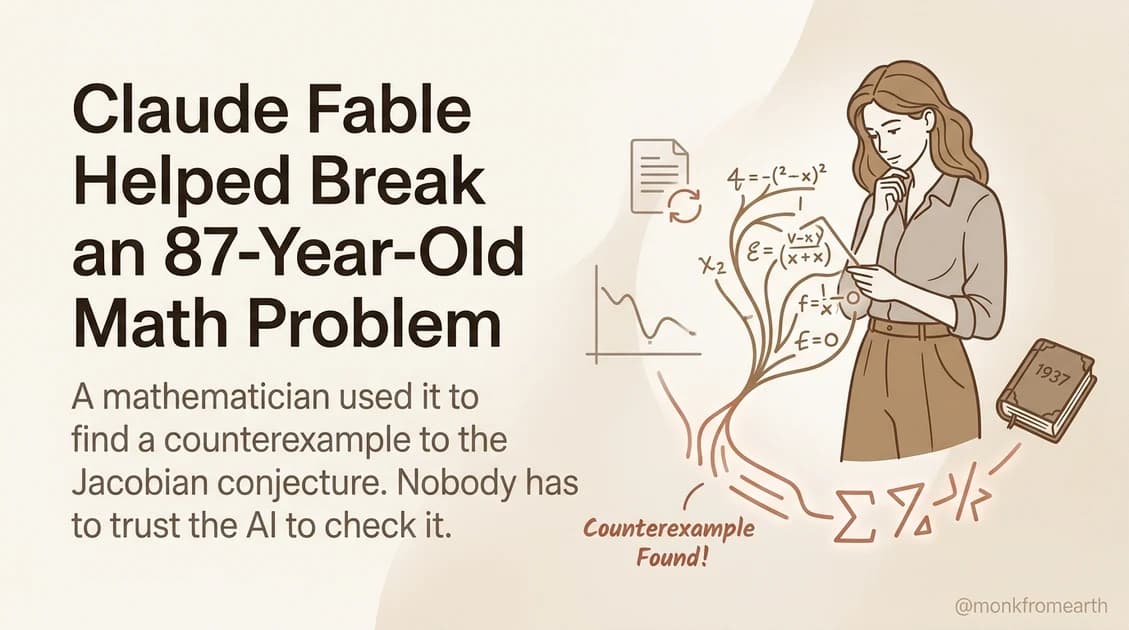
A working mathematician just used Claude Fable to find a counterexample to the Jacobian conjecture, an 87-year-old problem, and posted it in a single tweet with no fanfare. The map is three polynomials from C^3 to C^3. Its Jacobian determinant is a constant, nonzero minus two, and it sends three different input triples to the same output. [1] That last part is the whole story: a map that is supposed to be reversible sending three inputs to one place.
TL;DR: Claude Fable helped a mathematician at Anthropic find a checkable counterexample to a famous 1939 conjecture. The interesting part is not that AI did math. It is that the result certifies itself, which is why the question everyone is arguing about, how much of it was the AI, does not actually change whether it is true.
What did Claude Fable actually do to the Jacobian conjecture?
Levent Alpoge, a research mathematician at Anthropic, posted a polynomial map he found with the help of Claude Fable, Anthropic's latest model. Here it is:
F(x, y, z) = (
  (1+xy)^3 * z + y^2 * (1+xy) * (4+3xy),
  y + 3x * (1+xy)^2 * z + 3x * y^2 * (4+3xy),
  2x - 3x^2 * y - x^3 * z
)
Plug in three different points, (0, 0, -1/4), (1, -3/2, 13/2), and (-1, 3/2, 13/2), and all three come out as (-1/4, 0, 0). [1] Three doors, one room. A reversible map can never do that.
What is the Jacobian conjecture, in plain terms?
Picture a machine built only from polynomials. It takes three numbers in and gives three numbers out. The Jacobian determinant being a nonzero constant is a local promise: at every single point, the machine stretches and twists space by the same nonzero amount and never flattens it to nothing.
The conjecture, stated in full by Ott-Heinrich Keller in 1939, says the local promise forces a global promise: if the machine never flattens space anywhere, every output must come from exactly one input, and you can undo it with polynomials. [2] For 87 years nobody could prove it or break it in more than two variables.
Alpoge's map keeps the local promise, determinant minus two everywhere, and breaks the global one. Local check passed, global reversibility gone.
Why is this counterexample easy to check but hard to find?
Here is the asymmetry that makes the whole event work. Finding this map is decades-hard. Checking it is a one-minute calculus exercise. You substitute the three points, confirm they collapse to the same output, and confirm the determinant. Anyone who has passed a multivariable calculus course can redo the check by hand, and plenty of people already have. [3]
That gap, hard to find and cheap to verify, is exactly the terrain where an AI collaborator is both most useful and safest. You are not asked to believe the model. You are handed an object and you test it yourself.
Did Claude Fable really disprove it, or did a human do the work?
This is the part the internet is fighting about. Alpoge did not publish the reasoning trace, so nobody outside can see how much of the insight was Fable's search and how much was a strong mathematician steering it. [3] He also works at Anthropic, which is a fair thing to flag. The honest read is that we cannot cleanly separate the two contributions from a tweet.
Why does the question of who found it miss the point?
Because a counterexample is not a claim you have to trust. It is a self-contained object that proves itself.
A counterexample doesn't care who found it. A human, a search script, a model, a lucky guess, it makes no difference to whether the formula works. The formula either sends three points to one point or it does not, and this one does. Contrast that with almost everything else we ask AI to do, where the output is a paragraph you have to judge, an answer you have to double-check, a plan you have to trust. Here there is nothing to trust. There is only something to check.
That is why this landed without a peer-review circus. In most domains, "an AI helped" invites suspicion, because the AI's word is doing load-bearing work. In math, the AI's word does no work at all. The proof is in the object.
Where does AI as a research collaborator actually work?
The same place this did: fields where finding an answer is expensive but checking one is cheap. That is a specific and underrated shape of usefulness, and it is not "general reasoning."
- Math and formal proofs win first, because verification is a mechanical check.
- Program synthesis fits, when you have a test suite that instantly says pass or fail.
- Chip layout and protein candidates fit, when a simulator or an assay can score a proposal cheaply.
Where it does not transfer: taste, strategy, open-ended writing, anything where judging the output costs as much as producing it. In those fields the model stays advisory, because there is no self-certifying artifact to hand back. The winners are wherever a cheap verifier exists to catch a confident wrong answer.
Is the Jacobian conjecture counterexample peer reviewed?
Not yet, and this matters. The map has been verified by public direct computation that many people have reproduced, but it has not gone through formal journal refereeing, so the conjecture is still officially open in the record. [2] The counterexample also only touches the general case. The two-variable version of the conjecture is still unsolved. The steelman for the skeptics is simple: without the reasoning trace, "Fable found it" is a claim about process, not about the result, and only the result is verified.
What does this change about how we work with AI?
It shifts the default posture from ask-and-trust to propose-and-verify. Stop treating the model as an oracle whose answer you accept or reject. Start treating it as a partner that floods a search space with candidates while a cheap checker throws out the wrong ones.
The reason you want the checker is that models are confidently wrong all the time, and they will cut corners under pressure when a task gets hard. A verifier does not care about confidence or corners. It only cares whether the object works. That is why the same model that might bluff its way through an essay can be genuinely trustworthy on a counterexample: the bluff has nowhere to hide.
I have been building agents at Levo that work exactly this way, generating actions the system can validate before running, and the same principle scales from a dashboard command to a decades-old conjecture. The model proposes. Cheap verification disposes.
Key takeaways
- Claude Fable helped find a checkable counterexample to the Jacobian conjecture, an 87-year-old problem, in three dimensions.
- The map keeps a local promise and breaks a global one: constant nonzero Jacobian, yet three inputs map to one output.
- Finding it was decades-hard. Checking it takes a minute. That asymmetry is the real story.
- A counterexample certifies itself, so the "was it the AI" debate does not change whether it is true.
- AI works as a research collaborator where verification is cheap, and stays advisory where it is not.
- Not peer reviewed yet, and the two-variable case is still open. Verified by public computation, not journals.
The bigger pattern
The most useful thing a model did this week was not answer a question. It produced an object that answers for itself. As more of research gets a cheap verifier bolted onto it, that is the shape of AI collaboration that will keep working, quietly, without anyone needing to trust the machine.
I break down things like this on LinkedIn, X, and Instagram, usually shorter, sometimes as carousels. If this resonated, you would probably like those too.
Sources
Footnotes
The Simple Take
One email when something in AI or tech deserves more than a headline.
Not a digest. Not a roundup. The one idea that week, fully worked out.
Related