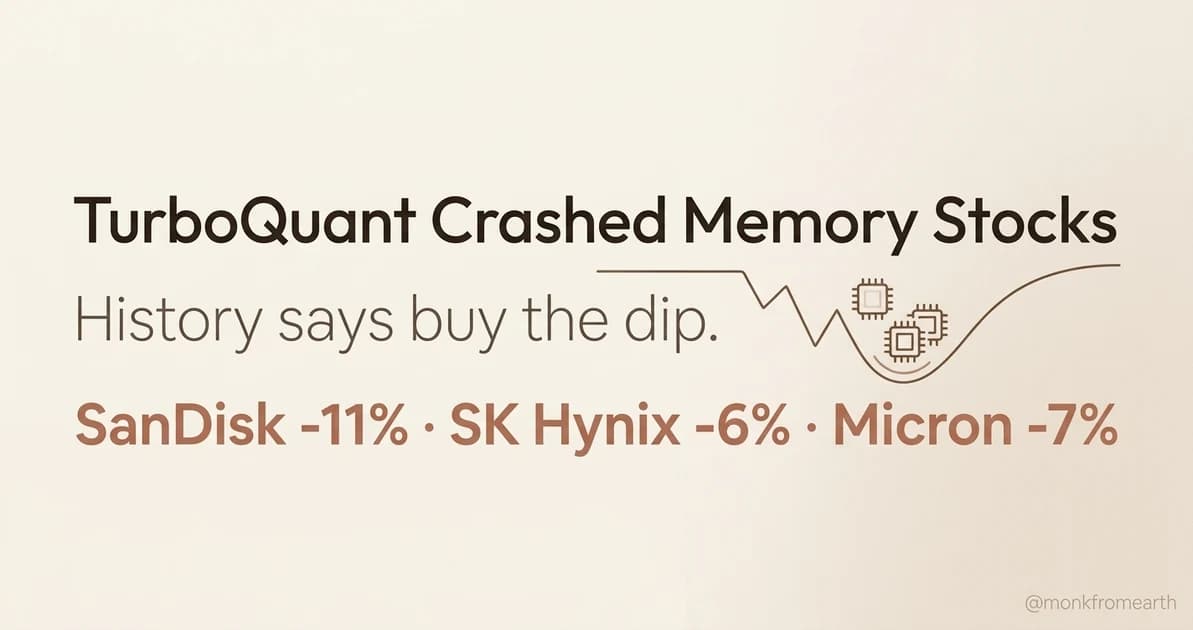
TurboQuant Tanked Memory Stocks. History Says Buy the Dip
SK Hynix -6%, Micron -7%, SanDisk -11% on launch day. Jevons Paradox predicts the opposite: 6x less memory per query means more queries bought.
TL;DR: Google's TurboQuant paper wiped billions from memory chip stocks in two trading sessions. SanDisk fell 11%, Micron 7%, SK Hynix 6%. But software efficiency gains have never reduced absolute hardware demand in computing history. Analysts are calling it a buying opportunity, invoking Jevons Paradox and the DeepSeek playbook.
What happened to memory stocks after TurboQuant?
Two days after I wrote about TurboQuant's technical breakthrough, the market gave its verdict. And it wasn't subtle.
On March 25, US memory stocks cratered. SanDisk dropped 11%. Micron fell nearly 7%. Western Digital and Seagate both slid around 4-5%. [1] The next morning, Asia followed: SK Hynix fell 6.2%, Samsung shed 4.7%, and the Philadelphia Semiconductor Index dropped 4.8%. Even Nvidia, which isn't a memory company, lost 4.2%. [2] In Shanghai, GigaDevice fell 5.9%. [3]
The logic was straightforward, if you squint hard enough: if AI models need 6x less memory for inference, then AI companies will buy fewer memory chips. Less demand, lower prices, sell everything.
That logic has a problem. It has never once been correct.
What is Jevons Paradox and why does it keep showing up?
In 1865, an English economist named William Stanley Jevons noticed something counterintuitive about James Watt's steam engine. Watt's engine was dramatically more fuel-efficient than its predecessors. You'd expect coal consumption to drop. Instead, it surged. The efficiency made steam power cost-effective for industries that couldn't afford it before. More factories, more trains, more ships. Total coal demand exploded. [4]
Jevons wrote a whole book about it. The pattern has repeated in every computing generation since.
Better video codecs didn't reduce bandwidth demand -- they made streaming viable, and bandwidth consumption went vertical. Virtualization didn't reduce server purchases -- it made compute so flexible that cloud computing became an industry. Moore's Law didn't reduce chip sales -- it made computing cheap enough to put in everything from cars to thermostats.
Shawn Kim, Morgan Stanley's head of Asia Technology Research, made exactly this argument about TurboQuant. Cheaper inference unlocks new tiers of AI adoption. Models that required cloud GPU clusters can fit on local hardware. Applications that were too expensive become viable. The memory gets bought -- just by more customers. [3]
He pointed to the most recent example: DeepSeek R1 in January 2025. DeepSeek showed AI training could run on cheaper hardware. Nvidia lost $600 billion in a single day. Then Nvidia recovered over 60% as cheaper AI expanded the total addressable market. [3]
How are analysts reading the TurboQuant sell-off?
The analyst reactions split into two camps, but the "buy" camp is louder.
KC Rajkumar at Lynx Equity explicitly recommended buying the dip, maintaining a $700 price target on Micron. His argument: compression techniques "merely reduce bottlenecks without destroying demand for DRAM and flash" over the next 3-5 years. [1]
Kim Dong-won at KB Securities said low-cost AI technologies like TurboQuant "are likely to lower barriers to adoption and significantly expand overall demand" -- ultimately benefiting the memory makers whose stocks just dropped. [2]
One analyst at Citrini Research compared the market reaction to "Aramco crashing because Toyota came out with a next-generation hybrid engine." [1] The analogy is sharp. More efficient engines didn't reduce oil demand. They made driving cheaper, which put more cars on the road.
The cautious voices are worth hearing too. Andrew Rocha at Wells Fargo noted that TurboQuant "directly attacks the cost curve" for memory demand and flagged uncertainty about whether lab results translate to real-world adoption. [1] Yoo Hoi-jun, a professor at KAIST, pointed out that "it is still a research paper that has yet to be validated, so its impact on actual memory demand appears minimal." [2]
But the quote I keep coming back to is from Luis Visoso, CFO of SanDisk -- the company that got hit hardest, down 11%. He said TurboQuant "can improve return on investment of hyperscale capital expenditures, and this increased efficiency could, in turn, cause demand to rise." [1]
The CFO of the company that lost the most is arguing the technology might increase demand for his own product. That's either peak cope or the most honest analysis in the room. I think it's the latter.
Is TurboQuant actually Google's DeepSeek moment?
Multiple outlets drew this comparison, and the surface pattern is hard to ignore. Both showed software could dramatically reduce hardware requirements. Both triggered immediate sell-offs. Both prompted analyst calls to buy the dip. [3] [5]
But there's an important distinction. DeepSeek was about training efficiency -- the upfront capital cost of building models. TurboQuant is about inference efficiency -- the ongoing operational cost of running them. Training happens once. Inference happens every time someone sends a message, runs a query, or asks an agent to do something.
If anything, inference efficiency has a stronger Jevons effect than training efficiency. When the cost of each AI interaction drops, usage compounds. Longer contexts. Bigger batch sizes. Always-on agents. Real-time processing. Every one of those means more memory, not less.
What's the actual timeline for TurboQuant adoption?
This is where the gap between "research paper" and "procurement impact" matters.
Google hasn't released official code yet. Open-source is expected Q2 2026. [6] Community implementations are appearing fast -- llama.cpp forks, PyTorch reimplementations, Triton kernels -- but these are enthusiast-grade, not production-grade. (I covered the technical details of how TurboQuant works if you want the full picture.)
Independent developers pushed to 2-bit precision within hours of the paper, but quality degraded noticeably. The practical sweet spot is 3-3.5 bits, which is where the zero-accuracy-loss claims hold. [6]
For TurboQuant to actually affect memory chip procurement at scale, it needs to be integrated into the inference frameworks that hyperscalers run in production: vLLM, TensorRT-LLM, NVIDIA's Dynamo stack. That integration is months away at minimum. Then there's validation, deployment, and the lag between software changes and hardware purchasing decisions.
Kim Rok-ho at Hana Securities noted that DRAM price increases are expected to persist through 2026 due to supply shortages, regardless of efficiency gains. [2] The demand pipeline is already committed.
What pattern should you actually watch?
Forget the stock tickers for a moment. The pattern that matters is structural, and it repeats with remarkable consistency:
- Efficiency breakthrough drops. Software shows it can do more with less hardware.
- Markets panic. Hardware stocks sell off on the assumption that "less hardware needed" means "less hardware sold."
- Efficiency lowers costs. The same workload becomes cheaper to run.
- Lower costs unlock new use cases. Things that were too expensive become viable.
- New use cases expand total demand. More users, more applications, more hardware sold.
- Demand absorbs the efficiency gains and grows beyond them.
This is the pattern with steam engines. With codecs. With virtualization. With Moore's Law. With DeepSeek. The question is never whether the efficiency is real -- TurboQuant's 6x compression is real and verified. [6] The question is whether the market is pricing in a research paper or actual procurement volumes.
History says those are very different things.
Key takeaways
- TurboQuant triggered a broad sell-off: SanDisk -11%, Micron -7%, SK Hynix -6.2%, Samsung -4.7%, Nvidia -4.2% [7] [2] [1]
- Software efficiency gains have never reduced absolute hardware demand in computing history (Jevons Paradox) [4]
- Multiple analysts (Morgan Stanley, Lynx Equity, KB Securities) recommend buying the dip [1] [3]
- DeepSeek followed the same pattern in January 2025 -- $600B Nvidia wipeout, then 60%+ recovery [3]
- Real-world adoption is months away; supply constraints expected to maintain DRAM prices through 2026 [2]
Frequently asked questions
Why did memory chip stocks drop after TurboQuant?
Google's TurboQuant demonstrated that LLM inference could use 6x less memory through KV cache compression. [6] Investors extrapolated that less memory per model means less demand for DRAM and NAND chips, triggering a two-day sell-off across SK Hynix (-6.2%), Samsung (-4.7%), Micron (-7%), and SanDisk (-11%). [7] [2] [1]
What is Jevons Paradox and how does it apply to TurboQuant?
Jevons Paradox, first observed in 1865, says that efficiency gains in resource usage tend to expand total demand rather than reduce it. [4] Applied to TurboQuant: when inference gets 6x cheaper in memory terms, more organizations deploy AI, models support longer contexts, and new use cases become economically viable. The memory still gets bought -- just by a larger market. [3]
Is TurboQuant like the DeepSeek R1 moment?
The pattern is strikingly similar. DeepSeek showed training could be cheaper, wiping $600 billion from Nvidia in a single day in January 2025. Nvidia recovered over 60% as cheaper AI expanded the total market. [3] TurboQuant shows inference can use less memory. Analysts expect the same recovery trajectory, though TurboQuant's inference focus may have an even stronger demand-expansion effect. [5]
Should you buy memory stocks after the TurboQuant dip?
Multiple analysts recommend buying: Lynx Equity maintains a $700 Micron target [1], Morgan Stanley invokes Jevons Paradox [3], and KB Securities expects expanded demand [2]. However, this is not investment advice. The bull case depends on efficiency expanding total demand faster than it reduces per-unit consumption, and on supply constraints maintaining prices through 2026.
I break down things like this on LinkedIn, X, and Instagram -- usually shorter, sometimes as carousels. If this resonated, you'd probably like those too.
Sources
Footnotes
-
Investing.com -- Why TurboQuant Is Rattling Memory Stocks [↩] [↩ [2]] [↩ [3]] [↩ [4]] [↩ [5]] [↩ [6]] [↩ [7]] [↩ [8]] [↩ [9]]
-
Korea Herald -- Memory Chip Sell-off [↩] [↩ [2]] [↩ [3]] [↩ [4]] [↩ [5]] [↩ [6]] [↩ [7]] [↩ [8]]
-
South China Morning Post -- Buy the Dip [↩] [↩ [2]] [↩ [3]] [↩ [4]] [↩ [5]] [↩ [6]] [↩ [7]] [↩ [8]] [↩ [9]]
-
Google Research Blog -- TurboQuant [↩] [↩ [2]] [↩ [3]] [↩ [4]]
The Simple Take
One email when something in AI or tech deserves more than a headline.
Not a digest. Not a roundup. The one idea that week, fully worked out.
Related