A physicist found the single operation that generates all of Mathematics
Andrzej Odrzywołek proved the EML operator generates every elementary function: sin, log, sqrt, pi. The first universal primitive for continuous mathematics.
In computing, one gate does everything. NAND is all you need to build any digital circuit ever made. One operation. All of digital logic.
Continuous mathematics had no equivalent. Sin, cosine, logarithm, square root each felt irreducible. The scientific calculator exists because we believed all of them had to be separate operations.
A physicist at the Jagiellonian University in Krakow just proved that was wrong.
TL;DR: Andrzej Odrzywołek found that the EML operator, eml(x, y) = exp(x) - ln(y), combined with the constant 1, generates every elementary function: sin, cos, log, sqrt, pi, e, and all arithmetic. It is the first universal primitive for continuous mathematics, found not by elegant proof but by exhaustive search. [1]
What Is the EML Operator?
The definition is three symbols and a minus sign:
eml(x, y) = exp(x) - ln(y)
Pair it with the constant 1, apply it recursively as a binary tree of identical nodes, and you get everything a scientific calculator can do. Exponentials, logarithms, addition, subtraction, multiplication, division. Sine, cosine, tangent. Pi, e, i. All of it. The grammar collapses to a single rule: S → 1 | eml(S, S). One structure, every elementary function.
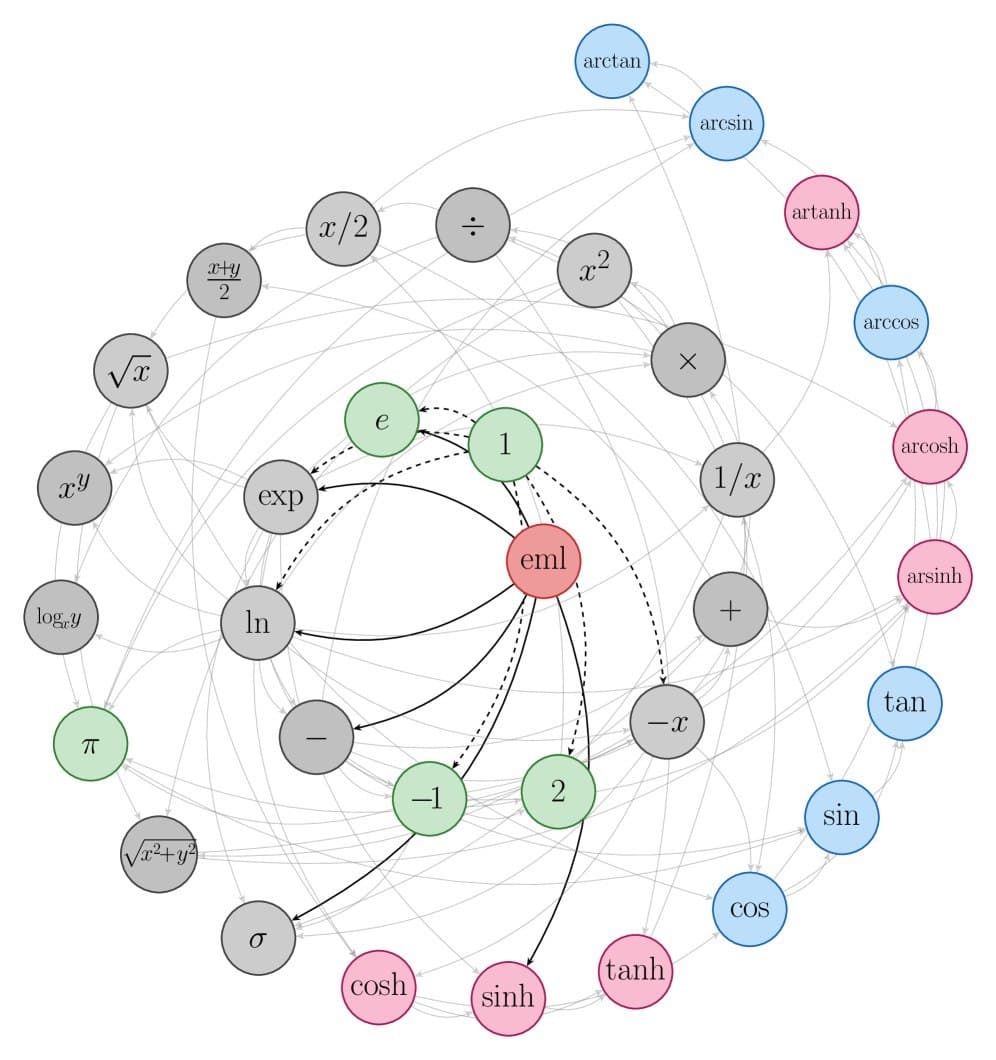
The diagram above, from the paper, shows how far the operator reaches. Every function radiating outward from a single node.
How Does the EML Operator Compare to the NAND Gate?
The analogy is close, though not perfectly symmetric.
The NAND gate is functionally complete for Boolean logic — every possible Boolean function, proven. Any circuit you can describe, you can build from NAND alone. This was established decades ago. We do not actually build hardware in raw NAND, but knowing the primitive exists tells you something about the structure of logic itself.
The EML operator is complete for a specific, concrete set: the standard repertoire of a scientific calculator — 36 functions, including the transcendentals, the hyperbolic functions, arithmetic, and the key constants. Not all of continuous mathematics by any broader definition, but the functions that physics and engineering actually run on. What Odrzywołek's paper establishes is that no comparable primitive had been known for this set before. That gap had existed quietly for as long as we had thought about mathematical primitives.
One caveat worth knowing: deriving trigonometric functions from EML goes through complex arithmetic internally, even when the output is real-valued. The machinery under the hood is not entirely elementary. The paper is explicit about this. [1]
Now it doesn't.
Why Was the EML Operator Discovered by Exhaustive Search?
This is the part I find quietly striking.
The discovery did not begin with a theorem. It began with systematic enumeration. Odrzywołek checked binary operators and tested which could generate the full set of elementary functions. The result, as he writes in the paper, was not anticipated. It was found by checking. [1]
We tend to assume the deepest truths in mathematics arrive through insight, a Euler recognizing the pattern, a Ramanujan dreaming the formula. This one came from methodically looking in the right place. The primitive that underlies all of continuous mathematics was there, hiding, not because it was difficult to understand but because nobody had searched for it systematically.

It is a reminder that a lot of fundamental territory in physics and mathematics is still unexplored. Not just at the edges of quantum gravity or string theory. In the foundations.
Key takeaways
- eml(x, y) = exp(x) - ln(y) is the first binary operator proven to generate all elementary functions
- Combined with the constant 1, it reproduces sin, cos, log, sqrt, pi, e, i, and all arithmetic
- It is the continuous-math equivalent of the NAND gate, a concept that existed for Boolean logic and now has an analog for continuous mathematics
- The discovery was made through systematic exhaustive search, not theoretical elegance
- Andrzej Odrzywołek of the Jagiellonian University in Krakow published the paper in April 2026 [1]
I break down things like this on LinkedIn, X, and Instagram. If this resonated, you would probably like those too.
Frequently Asked Questions
What is the EML operator in mathematics?
The EML operator is defined as eml(x, y) = exp(x) - ln(y). Combined with the constant 1, it generates every elementary mathematical function including sin, cos, log, sqrt, and constants like pi and e. Every expression is a binary tree of identical EML nodes applied to the constant 1.
Who discovered the EML operator?
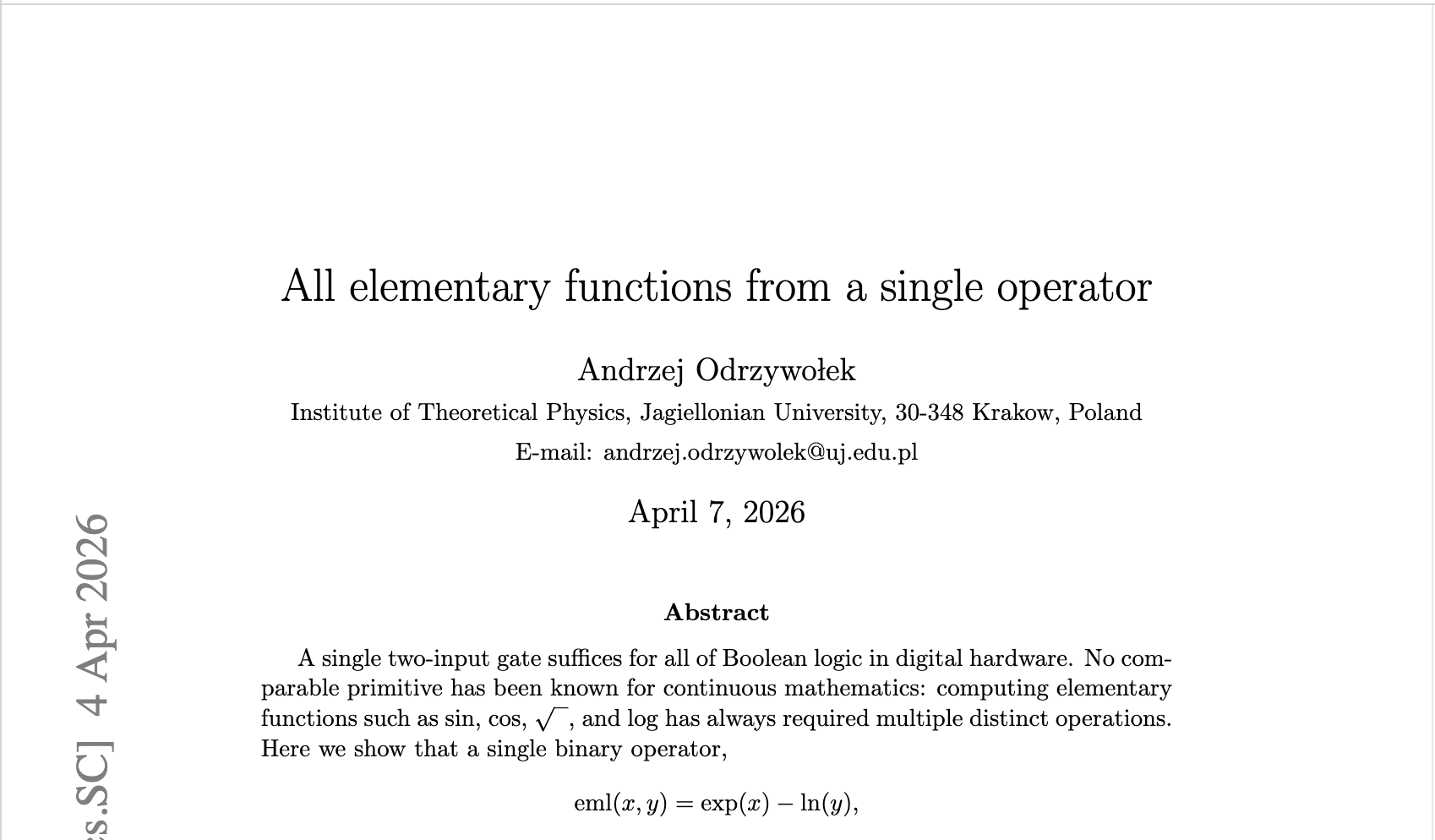
Andrzej Odrzywołek, a theoretical physicist at the Jagiellonian University in Krakow, Poland. He published the paper on arXiv in April 2026. [1]
How does the EML operator compare to the NAND gate?
The NAND gate is the universal primitive for Boolean logic: every digital circuit can be built from it alone. The EML operator is the first known equivalent for continuous mathematics. Before this paper, no single binary operation had been shown to generate all elementary functions.
How was the EML operator discovered?
Through systematic exhaustive search. Odrzywołek enumerated possible binary operators and verified which could generate the full set of elementary functions. The result was not anticipated before the search was done. [1]
What does EML stand for?
Exp-Minus-Log, which is exactly what the operator does: eml(x, y) = exp(x) - ln(y).
Sources
Footnotes
The Simple Take
One email when something in AI or tech deserves more than a headline.
Not a digest. Not a roundup. The one idea that week, fully worked out.